Showing posts with label Assyria. Show all posts

Wednesday, October 9, 2024

Ancient History - Part 50: The Fall Of Hatta


By the middle of the 13th century BC, warm relations grew to see Hatta become the chief supplier of iron to Egypt, this resource soon to rapidly spread throughout Asia Minor by the time Hattushil II passed. Two decades later, the venerable Ramses II followed. Hattushil's son, Dudkhalia II, named after the original Dudkhalia, the Great Uniter of the Hattic peoples, inherited the throne. Sadly, much historic record is missing, that which might have covered both his reign, and the life of his son, prince Arandas.

One thing that we know for certain about these lost years is that Carchemish and Aleppo, who historians theorize the Hittites lost control of, were firmly back in the possession of the Hattic empire, if they were ever lost to begin with. Carchemish was a focal city and absorbed into the greater part of Hattusa's capital, whereas Aleppo remained within Hatta's sphere of influence, its prince a loyal subject to his king.

During Ramses III's time, there is record that accounts for a great horde who conquered and ended Hattusa, with Dudkhalia possibly being the last ruling king, though internet sources, i.e. Wikipedia, dispute this and list Shubbiluliuma II as the Hittites' final monarch. Some suggest that both kings were one and the same. But as to the ultimate fate of the Hittites, the fact remains that Ancient Egyptian sources cite a wave of devastation in this unnamed horde who engulfed the entirety of the Cilician Plain, including Carchemish, Alashiya, and Arwad, and the Hittite people and their empire with it.

It has been covered previously that Assyria defeated both the Hittites followed by Babylonia, when the latter failed to arrive to her ally's aid. This call-to-arms, or rather, lack thereof, resulted in Assyria shattering the military of Hatta, leaving her indefensible to the savage hordes of the upper northern plains of Cappadocia, and later, Assyria's rule and total conquest of Babylonia.

Egypt opted not to aid nor abet, acting merely as a witness to the fall of her once enemy turned ally. The once great Empire of the Nile's full attention was heavily weighed by the rapid decline from within her own borders as internal decay began to rot down to the core. One positive for future nations that would spawn from this era of the collapsing dynasties is an emphasis placed upon the importance of border-security, in the forms of mitigation of the great migrations of people, as well as protection against organized foreign attack.


[DUDKHALIA II - The forgotten king]


Wednesday, October 2, 2024

Ancient History - Part 49: The Lion In The Room


Surprisingly, Carchemish was left off the Treaty of Kadesh. This has to led to some speculation that either a non-Hittite entity (such as Assyria) had absorbed the city during the negotiations between Hatta and Egypt, or more likely, Carchemish had already become a recognized part of king Hattushil's home capital, thereby needing no such formally written recognition in the agreement.

During this period, Shalmaneser I, the king of Assyria, had reached the Middle Euphrates, with his armies frequently setting raids from across the water. The target of these raids primarily included Hatta's ally, the Mitanni, who sustained the brunt of these attacks, and included their capital, Hanigalbat. Thusly, it is not unreasonable to put Assyrian occupation of Carchemish outside the realm of possibility here.

Whilst previously Egypt was frantic to accept swift Hattic friendship due to pressure from their alliance with Babylonia, it was soon the Hittite people's turn to ask the same of their former enemy. As westward expansion by Assyria encroached upon their lands, Hattushil drew upon letters to Babylonia and Egypt both, reporting aggressive movements of this powerful new threat. However, as we know, not much was done in the manner to curb the Hattic king's worry.

Even still, thirteen years after signing the Treaty of Kadesh, Hattushil concentrated on fulfilling strategic maneuvers to strengthen the bonds with his allies, and began by marrying one of his daughters to Egypt's pharaoh, Ramses, who would join his Royal Harem. The correspondence at this junction actually included Hattushil's queen, Pudukhipa, directly addressing matters concerning her daughter and the Egyptian lifestyle, and also Ramses asked for large supplies of smelted iron from his new kingly friend.

Generally speaking, it is very difficult to create a reasonably sized conglomerate of allied nations to defend against the level of danger that the war-hungry Assyrian army posed to the rest of the Near East. Egypt and Babylonia did not appear to treat this threat with the same manner of heightened care that Hatta did, and instead demonstrated clumsy foresight by the hands of Babylonia's king, and an agnostic interest at best on behalf of Egypt's, due to distance.

It's a reasonable basis in hindsight that the Hittites and their king were correct in fearing Assyrian expansion, but unfortunately their voices were drowned out in a sea of disinterest, a price all players with the exception of perhaps Elam, in the far east, would later pay at a supreme cost.


[KING HATTUSHIL II]


Wednesday, September 4, 2024

Ancient History - Part 45: The Syrian Principalities


The Hand of Nergal, a deadly plague, engulfed the lands of the Hittites, and by 1360 B.C. king Shubbiluliuma had fallen ill and died. His firstborn son and heir, Arnuwandash, too, succumbed and passed, thus the kingship was left to Murshil, Shubbiluliuma's second son and sole remaining male heir. Murshil's constitution prevailed and he soon ascended to the throne.

The first decade of Murshil's reign focused primarily on visits throughout Syria and engagements with local matters of state. There are several references etched upon cuneiform, recovered from Bogazkale, detailing the princes of Syria treating with the new king. Carchemish (Karkemish) appeared to be the most favorable amongst his subjects, though Aleppo (Alep) proudly reminded its citizens of their friendship with the ruler of Hatta.

Securing warm relations with his freshly conquered subjects was a matter of deep importance to Murshil, though in the case of Kissuwadna, vast effort was required. Shubbiluliuma severely chastened the prince and his people, but agreed to allow the city its autonomy if an alliance was drawn that Hatta's allies and enemies would be mirrored by Kissuwadna. After much deliberation, assurances were made and the city's loyalty and its alliance to Hatta remained intact with this younger king.

Following their betrayal, the Harri had scattered to the winds, relocating to various Syrian cities, and the wiser princes promised that should Murshil require reinforcements in future-wars, the Harri populace would be the first lines of enlistment. Murshil retained the friendship of Syria by agreeing to abolish the frontier fortifications that separated the border-states, especially now that his father's campaign against them had ended.

Lastly, outside of Syria and Hattic territory, Murshil adopted his late-father's stance toward the Mitanni. He understood the value placed on their continual existence as a buffer-state between Hatta and Assyria. As Assyrian power grew and threatened all that touched its ever expanding borders, an attack on the Mitanni would act as an alarm system, signaling danger to the greater Hittite state. Thusly, Murshil warranted that the Mitanni people would be permitted freedom to dwell and use the Tigris and the riverlands around it as their own.

A back door is a security flaw designed to directly admit the safe passage to the creator and by maintaining an ally with the Mitanni, it was a strategy that meant that the Hattic king could theoretically move an army through Hanigalbat lands to strike at a growing enemy, should the need arise, particularly, an Assyrian enemy.


[MURSHIL'S PRAYER TO THE GODS TO END THE HAND OF NERGAL]


Wednesday, August 7, 2024

Ancient History - Part 41: The Two Betrayals


King Tushratta of the Mitanni was no easy opponent, winning a great many of the initial engagements against the invading Hattic forces. For the entirety of his reign, Tushratta and his people were staunch loyalists to the Egyptian crown, and he reasoned that if his kingdom could demonstrate vigilance in the face of those who sought to destroy them, the Kingdom of Nile would surely embolster his defending nation.

Egypt, as we know however, was on the decline, and did anything but reinforce her Mitannian allies. Not only did the ill-prepared Egyptian forces fail to assist the Mitanni, but retreated from their occupied Syria soils at the first sightings of the Hattic enemy. Thus, despite winning on the field, king Tushratta ordered a tactical retreat back to his seat within Washukanni, the capital city of Hanigalbat that sat on the embankments of the Euphrates.

The king of the Mitanni dispelled any false notions of Egyptian rescue, for many months hearing from a distance how the Hattic army ravaged his land. Upon a brief deliberation, Tushratta recognized that his communication with Egypt was cutoff entirely, and was forced to consider suing for peace with Shubbiluliuma, rather than risk further annihilation. But the proud king was not to be swayed, this was a violation of property that he refused to throw out due to fear.

But the growing sentimentalities amongst his followers had morphed into dissension, and whilst his fighting spirit was undoubtedly hinged on the shoulders of honor and duty, a rebellious new faction was formed. This very faction, led by his own son Artatami II, betrayed the king, and the son violently slayed the father within his own palace walls, by way of razor, thus usurping the throne.

Hanigalbat then submitted to king Shubbiluliuma as overlord and by the time Tushratta's successor, Mattiuaza, assumed the throne, his entire kingdom was overrun by the Hittites of the west followed by the Assyrians of the east.

What strong leaders sometimes fail to recognize is that the the standard to which they hold themselves to does not necessarily apply to others. Tushratta reasoned that together with Egypt, they would expel the Hattic enemy, completely blind to the possibility of Egypt acting in cowardice. His capital stronghold being situated on an everflowing river, where he fortified knowing Washukanni impenetrable, could outlast the invasion. And yet his treacherous supporters and family murdered him.

History would have played out so very differently had only Tushratta simply continued to fight and trusted no one, holding true to the abilities of his own leadership and desire for his nation to remain independent.


[METHOD OF COMMUNICATION BETWEEN HANIGALBAT AND EGYPT (Amarna Letter, above)]


Wednesday, July 24, 2024

Ancient History - Part 39: War and Peace


[A united Hattic Kingdom under Shubbiluliuma]


Shubbiluliuma removed the Harri people from Kissuwadna, confining them to the other side of the Euphrates, where they adopted the lifestyle of riverfolk. In the days that followed, the Hattic king's favorable treatment earned their obedience. The fatal mistakes that monarch-kings often make tend to be leaving problems unsolved, ones that continue to fester, and Shubbiluliuma's handling of Harri in a way that did not result in mass genocide or civil war was something the world took note of.

Next, he traveled to Syria to treat with the princes who ruled from their impressively rich city-states. This entire area bore spheres of influence that included princes aligned with the Mitanni and others with Egypt. In the case of the Mitanni, the Syrian princes were offered protection; with Egypt, innovation; but in the case of Hatta? War.

Shubbiluliuma did not enter Syria with peaceful intentions and carried the near full force of his armies into their lands. The Hattic king wisely chose to leave his internal struggles almost bloodless, but the opposite was true for the external challenge of staking a claim in Syria to form a new dynasty under his one rule. This move was unprecedented and a brutal one, taking Syria itself, along with its new allies in the Egyptians and Mitanni, completely unawares.

It is a fool's bargain to believe in others blindly fighting your battles for you upon nothing more than their word, and when the Hattic soldiers began their raids, Egypt and Mitanni occupied areas also fell to Shubbiluliuma's grasp. The local chieftains quickly submitted and before the Near End knew it, the Hattic nation now possessed all of northern Syria. King Shubbiluliuma's people remembered the old days written and told via oral tradition of the fierceness of the Assyria, and establishing this foothold in upper Syria was considered an effective posture against any notion of western expansion.

Just as one country might absorb another in order to create a buffer of sorts, this was the will of Shubbiluliuma's people, however, his own two reasons were entirely different.

Legacy and power.


[THE DEEDS OF SHUBBILULIUMA]

Wednesday, July 10, 2024

Ancient History - Part 37: Hittite Imperial Power


[EMPIRES OF 1300 B.C. (BY COLOR) - HITTITEEGYPTIAN; ASSYRIAN-BABYLONIAN; MYCENAEAN]


Moving backwards and with an introspective eye on the former Hittite empire:

The Hittite civilization dwelled primarily in eastern Turkey (specifically, Anatolia), northern Syria, expanding throughout the 15th to 13th centuries to the Euphrates and the Mycenaean coastal waters. The power of the Hattic capital stood within Cappadocia.

It was from this power center around 1450 B.C. that king Dudkhalia established correspondence with the surrounding powers. These included but were not limited to Hanigalbat and Aleppo. Impressed by the Hittite king's shrewd attitude along with a willingness to share in the wealth that his friendship might suggest, Dudkhalia united a region known for its warworn history without ever firing a single arrow.

Upon Dudkhalia's passing, the throne went to Hattushil, a man who clashed for control against an opposing faction within the Hattic lands. This faction, ethnically Harrian, were supported by both northern Syrian people as well as the native riverfolk of the Euphrates. While the historic details might be described by some as sketchy at best, the following generations were predominently Hattic in nature, ushering in the imperial period of the Hittite empire, and thus signifying Hattushil's victory amid this struggle.

The last bastion of hope for the opposing Harrian leadership was towards the end of Hattushil's reign (1415), which saw a revival of sorts rebel against the Hattic king. At the far south, within a place called Kissuwadna, the Harrians rallied the surrounding southern lands in revolution. Simultaneously, Assyria's soldiery began to encroach from across the Euphrates and into Tauric territory (Crimean migrant lands) from the east. This started a fifteen year trajectory of growing opposition for Hattushil's successor, his son, and most famous of the Hittite kingly line, Shubbiluliuma.

All empires crumble sooner or later, finger pointing aside, the same pattern remains ever prevalent to this day. But the beauty and awe of an empire at its peak is still something for a historian to behold. Hattusa, Hittite, Hatti, Hattic, Hatta, Hattan... These are all variations describing a people who existed a long time ago primarily in what we now consider the country of Turkey who had many kings of impressive measure, though more than a few who suffered significant missteps in focal decision-making. Our retrospective on the Hittites and the rise and fall of their kingdom begins henceforth.


[HITTITE METALWORK]


Wednesday, July 3, 2024

Ancient History - Part 36: The Lesser of Two Men


[KING MARDUK-NADIN-AKHE OF BABYLONIA]


The time for peace expired by the end of Tiglath-pileser's reign as the despot of the Orient waged battle with the king of Babylonia, Marduk-nadin-akhe (1116-1101).

If a word could be said about Marduk-nadin-akhe it might be "bold", as the king order a raid upon Assyria in the year 1107 B.C, where his soldiers murdered and stole two major religious artifacts, the statues of the Assyria gods Shala and Adad. The greater crime was not the slaying of the citizens within close proximity to the statues, but rather the grave offense to their religious customs that brought the two nations to war.

At first there were a series of excursions leading the armies to clash in small skirmishes. This was a way for both sides to gauge the other side's mettle. However, it was the most heavily documented and largest of the early battles that bore significant results.

Both armies met for a full-scale collision at Lower Zab, stomping grounds the Assyrians had become extremely familiar. It was at this battle site that they routed the Babylonian forces, sending a large remainder in retreat, as they reclaimed the mountain territory and regrouped. The time for a subsequent battle yielded even more definitive results as the old king of Assyria fought the encroaching army near his own city of Akkad (specifically, Upper Akkad).

Tiglath-pileser not only defeated king Marduk-nadin-akhe's army, destroying every unit to the last man, but in retaliation, counter-attacked, launching a full-scale invasion upon Babylonia, who without a standing army, could no longer defend herself. First Dur-Kurigalzu fell, before Babylon and Opis soon followed. More towns and smaller cities were plundered and the Assyrian king had one final day of celebration to end his legendary time of rule.

The massive strategic error of Marduk-nadin-akhe's decision in attacking Assyria is the reminder that weaker men tend to pose within the shadows of truly great leaders. It's a pattern that usually sees the pettier of two rulers to act out as a bratty child might against their elder, leading to a violent confrontation, ultimately dooming the lesser individual's very subjects. They alone bear the price of their king's petulance and the king of Babylonia in this case highlights such a historic example.


[DUR-KURIGALZU]


Wednesday, June 26, 2024

Ancient History - Part 35: A Kingdom United


For just a limited time, there was some semblance of peace, if it could even be imagined. So much bloodshed and war once again soaked the lands of Asia Minor, and yet the campaign had ended.

Following his conquests, Tiglath-pileser was a man of many leisurely interests. He possessed superior quality hunting skills and bore a penchant for hunting elephants, particularly upon the Euphrates, admiring them for their size as well as the challenge that accompanied their tenacity for survival. Elephants were not all he hunted. He often boasted of slaying lions by chariot and nearly as many by foot. Wild bulls were another favored sport, commonly found throughout the plains bordering the Arabian Desert.

The Assyrian king did more than just hunt, rebuilding many temples throughout his vast kingdom, most notably Ishtar, but also the historic Adad and Anu, among others. He took particular strides to improve not just the temples of his own god, but the new subjects who knelt beneath him, such as the Amorites and other Semitic tribes folk. With the flair of an architect, he constructed new palaces and refurbished the old.

It wasn't merely culture and leisure that was his focus, but practical applications as well, as water-mechanisms that aided in transporting water long distances were repaired along with granaries built to store grain for the people. His breeding techniques from back home were implemented to improve the number of cattle, horses, donkeys, and sheep, thereby eliminating starvation amongst the kingdom. Tiglath-pileser is solely credited with the tripling of populations of wild deer and wild goats of Syria.

Tiglath-pileser was also fond of this foreign plant-life and took great efforts to curate massive exotic gardens and parks everywhere he traveled. This same affectation extended to the indigenous animal-life new to his eyes and it is said that the Egyptian king presented him a gigantic crocodile as a gift. For a time, Assyria had earned the respect from world's greatest detractors.


Wednesday, June 19, 2024

Ancient History - Part 34: The Fight For Phoenicia


Quelling the northern district, king Tiglath-pileser crossed south-east beyond Lower Zab, conquering further into the lower mountain lands that laid in wait. Assyria's armies did not get far before news broke that the Kurti left behind had revolted in the north. Rather than risk falling for an old canard at worst or accepting distraction at best, the Assyrian king chose to remain in the southern district, his forces encroaching upon land belonging the Nairi people.

There, a collection of leaders, totaling twenty three kings and the warriors who followed, met Tiglath-pileser's men in the field. Again, the Assyrians triumphed. With the Nairi and her allies soundly defeated, the Assyrian had shattered all opposition on two of her sides. The western and northern districts remained a troublesome nuisance however.

Within Hanigalbat, the former lands of the Mitanni, the city of Malatya, along with her sister strongholds resisted. In the old Hittite empire, Carchemish and her sister cities raised arms to ready a counter-assault intended to push back against Assyrian expansion as well. Rumor had swelled that even in Cappadocia, specifically Cataonia, warriors trained daily in their steadfastness, expectant of any pending attack.

Despite the challenge that waited in earnest, Tiglath-pileser never once succumbed to fear. From Lower Zab to the opposite side of the Euphrates, his forces marched forth, and in the end, by the fifth year of the warrior-king's reign, forty-two countries and kingdoms were conquered at his hand. The Assyrian king left his mark in many ways:

  1. Rock sculptures and cuneiform left at Nahr el-Kelb in Phoenicia.
  2. Tolled Lebanon of their strong trees, particular cedars, for building material.
  3. A portrait of himself was sculpted into the cliffs of the Nairi heartland.
  4. All cities now paid Tiglath-pileser tribute in gold during his visits for the remainder of his reign.
The inevitability of Assyrian expansion during this period was undeniable and even though many civilizations resisted, upon defeat, these smaller kingdoms relented to taciturn servitude than to sacrifice more lives in a fit of negligence. 


Wednesday, June 12, 2024

Ancient History - Part 33: New Direction, Same Directive


[THE COMMAGENE KINGDOM WITHIN THE LANDS OF ARZANENE]


Despite his hungry nibbling at the disorganized former Hittite lands, king Tiglath-pileser's victories on the west were soon plagued by a distraction back home. The Commagene people had risen once again in open-rebellion causing the Assyrian king to return with a vengeful aim at retribution. But once he did return to the northern outskirts of Assyria, he'd found that the majority of the uprising voices had absconded to their mountain fortresses.

Irked at his inability to reach the dissenting voices amongst the Commagene, as they each lay hidden safely within dangerously steep holdfasts, Tiglath-pileser and his advisors knew it would be a lengthy wait to starve the rebels out. And yet, wait they did, but not for so long, as the local inhabitants of the mountain lands, beginning with the Kurti people then others to follow, took umbrage with Assyrian soldiers upon their soil.

Quickly forgetting the rabble who'd withdrawn to the mountaintops, king Tiglath-pileser found himself filling the shoes of a conqueror once again, and it was said that upon finalizing his excursions, the Assyrian army had overtaken twenty five cities and countless villages. The lands of Arzanene (modern Armenia) and lands that extended to the great river now known as Amu Darya were all captured.

Many of these places surrendered to the much greater Assyrian forces without resistance. Fight or no fight, the result was the same, their lands became Tiglath-pileser's land, and a greater part of Assyria's borders had expanded once again.

The irony in the Commagene's uprising is that no matter which direction the Assyrian king would have chosen to expand, expansion would've occurred. His original intent decided upon the west, but with the Commagene drawing his attention back north, his military simply shifted geographical objectives and the mountain villages suffered a great wroth by proxy on behalf of their well-hidden and troublesome neighbors.

Rather than be gored by Assyria's might on the field, the people within the Arzanene region submitted whilst withholding any desire to grumble, but as the years beyond will tell they'd opt to fight another day. 

Another day and against another king.

---------------------------------------------------------------------------------------------------------------------

Typical mountain village during this period (as rendered by archaeologists by the 1800s):


Tuesday, April 30, 2024

Ancient History - Part 32: Assyrian Conquest Continues


Assyria continued her brutal demonstration into rebellious territory, tribes and countries refusing to submit to new taxes and authority soon bent the knee, finding themselves subdued. It wasn't long until Assyria found herself deeply meadowed within the former lands of the Hittite Empire. The once mighty empire now consisted of Hittite blooded natives intermixed with the different migrations of the previous two generations that had since moved into its ruins.

Of these new residents of Hatta, referred to in text as "soldiers of the lands of Hatta", four thousand stood tall against the pending onslaught that mighty Assyria had brought with her.

Upon the sight of the eastern superpower's forces, four thousand surrendered, without so much as a drop of bloodshed spent. King Tiglath-pileser wisely kept his aims upon the outskirts of the former Hittite lands, poaching from smaller parcels where his numbers were greatest and security most intact.

Satisfied with a campaign that overwhelmingly resulted in Assyria's favor, Tiglath-pileser collected over a hundred chariots, wagons, and other wheel-vehicles of miscellaneous type, returning home to tribute Ashur, his godly deity of the capital city's namesake.

It is here that we must raise the question of whether or not facing Assyrian incursion with resistance during this period was nothing but a fool's bargain. The Assyrian kingdom was rapidly expanding into a formidable empire and to stand in the way of its imperialism of the Near East guaranteed a prize of. . . nothing. As the four thousand strong (Kashkai) who stared down the armed forces of their conquerors would attest, their interception of the enemy only promised their doom.

The worst experience for a soldier on the battlefield is not necessarily the fear of death itself, but the realization that one's sacrifice bears his country nothing to gain.


[LANDS OF THE HITTITES AT ITS FORMER EMPIRE'S PEAK]


Wednesday, April 24, 2024

Ancient History - Part 31: Keep Your Friends Close


By the late 1100s B.C., people eventually began to understand that Assyria was the true last remaining superpower of the Near East. Despite any losses on the battlefield and the occasional rulership of a petty king, Assyrian population was on a boom, the military only increasing in strength, and the culture possessed a resilient spirit that made them a menacing enemy for any in her path.

And so Assyria's military units struck Commagene, whose defenders were no match for the greater forces of king Tiglath-pileser. Homes were set ablaze, citizenry executed, and the lands pillaged. This assault was a moment of great importance securing Tiglath-pileser's reputation as a ruthless king and Assyria's reputation as no-nonsense political entity.

Commagene, ruled by king Kili-Tesrub, sealed the fate of his kingdom upon the refusal to pay new taxes levied by Tiglath-pileser and the surviving populace fled across the Tigris River. This diaspora of Commagene people intermingled with the Kurti tribesmen and formed an alliance, well away from their abandoned homeland.

Only one stronghold remained manned within Commagene, a mountain fortress that refused to surrender, and was held by Kili-Tesrub's brethen, Shadi-Tesrub.

King Kili-Tesrub of the exiled Commagene gathered his new allies and recrossed the Tigris in an attempt to regain the lands Assyria had taken. A massive battle took place in a fight for the Commagene kingdom, but in the end, Kili-Tesrub was captured, along with his treasury, and when news spread Shadi-Tesrub surrendered the Commagene people's last redoubt, his fortress, to the Assyrian army.

While many leaders during this era preferred to secure the unity of their people and tout this as some great success, now there was an external threat which stole their attention. The display of power that Assyria enacted upon its own ally, the Commagene, after defeating their enemies for them (the Moschi), created a heavy contemplation for Assyria's future moves. Assyria held all of the cards. And now the world was watching.


[RECORD OF TIGLATH-PILESER I'S MILITARY ACHIEVEMENTS]


Wednesday, April 17, 2024

Ancient History - Part 30: Always Pay Your Debts


Nebuchadrezzar died shortly after his defeat at the hands of Assyria signaling the beginning of a period of decadence in the Near East. Egypt was approaching its collapse. The Hittites along with their neighbors had been engulfed by the barbarian hordes of the west. And the once mighty Babylonia, now weakened, reverted back to a period of petty kingships.

Without opposition, Assyria's opportunity to once again expand her borders rose to fruition with the ascendency of Tiglath-pileser (1115-1102) to the throne. The Moschi people had sometime earlier (est. 1170-1160) captured historic Assyrian lands on the kingdom's north-east region. Their fifty year rule of the Alzi and Purukuzzi provinces would culminate in a violent confrontation.

In Tiglath-pileser's first year as monarch (1115), the five kings of the Moschi mustered an army of twenty thousand strong and set forth to further invade Assyria and her surrounding allies, particularly the small kingdom of Commagene, a vessel state subservient to Assyria. In this battle, the young king of Assyria slew many enemies himself, and upon the defeat of the Moschi, the corpses were decapitated, collected and piled into bundles, and transported back to Ashur along with six thousand newly acquired slave-prisoners.

Upon his return, Tiglath-pileser declared that with the aid of Ashur he'd gathered his war-chariots and crossed into the Commagene to defeat same the false-kings who defied them for half a century.

Despite their rescue at the warrior-king's hands, Commagene was not particularly appreciative. Perhaps there was a disagreement between the two nation-states upon who bore the fiscal responsibility for the war effort, as the smaller kingdom refused to pay Assyria its newfound levied taxes. King Tiglath-pileser was faced with a difficult decision. If he'd allowed such liberties to be taken at his throne's expense, then other disloyalties would certainly follow.

In the end, king Tiglath-pileser came to a decision. For her refusal to pay recompense, Commagene must be put to the torch and her people to the sword.


[TIGLATH-PILESER I]


Wednesday, April 10, 2024

Ancient History - Part 29: Mind Over Matter


Upon the victory of Elam's expulsion, king Nebuchadrezzar was not finished. His eyes turned northward to Babylonia's other oppressor:  Assyria. It was during this period Assyria's king was Ashur-resh-ishi I (1127-1116), a man full of vitality with an energetic presence. A monarch of such nature seated upon a throne possesses the potential capability to inspire his entire nation to its ultimate success or failure with just a mere word.

It should also be noted that king Ashur-resh-ishi I had already amassed a number of modest, but no less notable achievements, which included stemming the migrant crisis of the Akhlamu, containing the foreign-based nomads to Assyria's south-east boundary. He'd led Assyria to victory over the hostile people of the Lullume, who encroached upon the east, dispersing the survivors elsewhere. If push came to shove, this king would be a formidable opponent for Nebuchadrezzar on both the intellectual and the literal battlefield.

Despite this knowledge available to him, Nebuchadrezzar formally declared war upon Assyria, mounting an aggressive march to attack. And yet, Ashur-resh-ish I tempered his response, and strategically blocked all the inroads to the central portions of Assyria. With news from its scouts, the Babylonian army frequently avoided large encampments upon smooth roads in favor of traversing rougher terrain in order to storm what the king of Babylonia thought would spell out certain defeat for the Assyrians.

Unfortunately, this tactic only slowed the marching Babylonian forces. Eyes were easily maintained upon troop movements, and when the time had come for Assyria and Babylonia to clash, it was on the terms of the defenders and their placement of the board. Naturally, Nebuchadrezzar's forces were not only halted but routed. The Babylonian king and the elite portion of his army managed to retreat back to the safety of their lands, but not without incurring heavy losses, forty chariots and the heroic figure to his men that was their chariot-leader, Ritti-Marduk.

In the aftermath of these campaigns, the good news for Babylonia was that Nebuchadrezzar managed to move his kingdom away from Elam and back to his people, theoretically passing control onto the landowners, and by default, the working populace. The bad news was that his overreach into Assyria no longer guaranteed the safety of this very freedom they'd won. With the defeat of his army, the spirits of his people no longer bore the same enthusiasm as when Elam was beaten.

An adherence to the doctrine of knowing when to fight and when not to fight was something sorely missed by Nebuchadrezzar, something the fiery king appeared never to consider.

[ALTAR OF TUKULTI-NINURTA - *Prayer site of Ashur-resh-ish and his soldiers before battle]


Monday, March 25, 2024

Ancient History - Part 27: The Hero Who Was Promised?


New Babylonia, referred to as Pashe, had a total of eleven kings spanning less than 150 years. Initially plagued by the rule of a number of petty kings, it wasn't until the throne had succeeded to its first great king, Nebuchadrezzer I (1146-1123) that this new Babylonia began its traction in the direction of regaining long lost prestige. Blood-hungry for vengeance, the Pashe king declared his intent to wage two wars against the very two kingdoms that wracked ruin upon his nation: Assyria and Elam.

In Babylon, the Kassites had fully embraced and were embraced by the temples, learnt of the native tongue, and practice-tablets were used to conduct their full integration into the nation's faith. In Isin, administrative tasks were taught to overseers that once mastered were sent to other areas of the kingdom to manage organized governmental policy of the king. Dresswear advanced as the Kassite culture fully blended with the Pashe and a new cultural identity was bred out of the pain this generation and its previous ones had endured.

Lastly, new weapons that included sharper metal carved arrows, longer ranged bows, stern maces, and daggers were fashioned for the soldiery that had been waiting for a strong leader to call upon them to strike back against their invaders.

At this time, Assyria faced hardships within her dominion, the Mushkai people (former Hittites that migrated within Assyria's borders) began to rebel, and overran two key outposts, Purukuzzi and Alzi, creating civil unrest. Elam on the other hand cooled on its encroachment of Babylonia, especially as defensive armed forces grew under new Pashe organization.

This powder keg readied explode as the leverage of the two oppressors waned, and a new Babylonian "hero" was born in Nebuchadrezzer. Elam did not approve. Shilhak-In-Shushinak, king of Elam, invaded further into Babylonia where he was met in battle by Nebuchadrezzer along the banks of the Ukni River, in the southeast. It was April when Nebuchadrezzer and his forces were soundly beaten and driven back, and whilst a valiant stand was made, the invading Elamite units were much too battle-tested by the comparison of Nebuchadrezzer's hot-blooded youths.

No choice than to consolidate his remaining forces in a grand retreat back to the capital, Babylon, with the Elamite army potentially on his trail, the bold young leader prayed before Marduk, seeking out an answer for his people.

[MARDUK - PATRON GOD OF BABYLON]


Sunday, September 3, 2023

Ancient History - Part 4: Uneasy Peace


Despite peaceful relations with Assyria and Babylon, Egypt mounted a continuous Palestinian campaign. Under the rule of Amenhotep II (1447-1420), the empire of the Nile quelled any civil unrest, amongst the rebellious Semitic people, before moving its armies back into the lands of Syria. While this march was no more than a nominal success, the Mitanni (the westward neighboring state to Assyria) suffered great losses which resulted in a significant displacement of their power and people. So much harm did the Mitanni sustain, that it left them in no other position than to plead for the mercy of Ra's chosen people.

Amenhotep II's successor, Thutmose IV (1420-1411), believed that if the Mitanni could be cooed into friendly terms, much like Babylon and Assyria, there was untapped potential in securing a third subordinate ally. Therein lay the predicament: The king of the Mitanni, Artatama I, was already fiercely befriended and trusted by the Hittites, the chief rival of Egypt. Even though by mid-15th century B.C., war between the Egyptians and the Hittites had been generally reduced to mild skirmishes (upon Syrian soil), tensions continued to boil, and each passing day both sides expected grand-scale battle to resume.

The Egyptian king thusly proposed a royal marriage between kingdoms. Thutmose IV would marry Artatama's daughter, a symbol of protection, one that accompanied the trust that Egypt would harbor no further attack upon the Mitanni any longer, but such a promise would warrant a step even further. Egypt allowed the Mitanni to enter the fold of its vision. With a single marriage, a shockwave rumbled throughout the Near East. The Mitanni's allegiance officially shifted from the Hittites to the Egyptians.

This new development did not rest easily with the two nations of Assyria (ruled by Ashur-bel-nisheshu) and Babylon (ruled by Kara-indash). Unlike his predecessors, for Thutmose IV, the Mitanni were now quickly becoming the Egyptian king's his favored state, or so it appeared.

The two rulers east of the Euphrates agreed upon one thing: Despite any ill-bearing or mistrust they'd once harbored for the other, it must all be set aside, in order to form a united defensive front, should any attack, no matter whom the would-be conquerors be, be led. 

Assyria began refortifying its towns and their city of Ashur, strictly insuring that no weak points existed amongst the battlements. Meanwhile, the Kassites of Babylon were in a state of constant patrol along the borders. 

However, these expectations of a pending defensive war were all for not. Thutmose IV passed away (1411) and his successor, Amenhotep III (1411-1375), immediately sent envoys to treat with Babylon and Assyria. This new king made his intentions well-known; he possessed no desire to expand into the northern mountains of Assyria nor the vast lands eastward into Babylon. He'd admired their nations as loyal subjects and wished to maintain a focus wholly upon the true sources of Egypt's discontent, the unending Palestinian and Syrian wars, respectively.

Amenhotep III's assurances did not go unchallenged by both Ashur-bel-nisheshu and Kara-indash, and when pressed for further explanation, he convinced them that the Egyptian people were a culture well-conditioned to the dry lands of the desert heat. They were not groomed for a cold wintry life in the mountains, pacifying the argument justifying Assyria's fear of the Egyptians as would-be conquerors of their land. When it came to Babylon, Amenhotep stated that the Euphrates River was an unmistakable natural boundary, and officially declared that Egypt would never expand beyond it.

At the conclusions of these entreaties, all sides departed. Satisfied.

Thursday, August 10, 2023

Ancient History - Part 3: The Babylonian Question


Once friendly relations were firmly established with Thutmose III's powerful Egypt, Assyria turned southward to Babylonia. Other than the Mitanni, who once rattled their borders with oppressive raids prior to Egypt's intervention, Babylonia, as ruled by the Kassites, was the nearest neighboring civilization. Following Egypt's grand conquest of the Near East's coast and strategic areas within the Mesopotamia, now was the perfect opportunity for the Assyrian king, Puzur-Ashur IV (1486-1460 B.C.), to address the Babylonian Question.

Would it be peace or war?

The Egyptians had seen fit to allow resident countries to preside over agreed upon boundaries as long as they continued to pay tribute (taxes) in the form of goods and precious rocks and metals used for what passed as currency at that time. How these different peoples interacted with one another was an entirely separate matter.

Not much is known of Puzur-Ashur's reign of Assyria, other than a few short pieces of note:

  • He restored the temple of Ishtar, which one might surmise was thoroughly desecrated at the hands and ill-treatment by their immediate neighbors, the Mitanni, though this is unconfirmed. At present, historians have it on record that the temple did fall into a state of decay and he'd restored it back to its once pristine condition, no less fit for Assyria's chief place of reverence.
  • While no major battles or wars are accounted for during his lifetime, the Assyrian king did commit strenuous efforts and time dedicated to the building of a new defensive structure, a protective wall for Ashur, their capital city, that would shield the newer southern districts that their growing population had rapidly expanded into, a much needed response to any outside danger.
  • But perhaps his grandest recorded accomplishment was the negotiations with the Kassite ruler of Babylon, Burna-Buriash I (1461-1436), where the two met and agreed upon establishing the precise borders between their respective kingdoms. Assyria already carried the experience in such negotiations with the Egyptian empire, that in this case, found themselves as leading the way as opposed to following, and as it was between Thutmose III and Puzur-Ashur IV, it was with Puzar-Ashur IV and Burna-Buriash I.

For the many years that followed, there was a prolonged period of peacetime amongst kingdoms and empires. At one point Burna-Buriash I's successor, Kurigalzu II (1435-1411), was invited by the Canaanites to wage war against Egypt, with a promise of a piece of the Semitic lands that they were so desperately yearning to liberate. To this, Kurigalzu declined, and each of his successors were continually solicited to turn against the great empire of the Near East. Just as their forbearer once demonstrated, each Babylonian ruler also declined, referring to the Egyptian pharaoh as "my brother."

The Egyptians had established dominance for this century (15th century B.C.) by making friends where enemies might once had surfaced. However, as history will often remind, nothing lasts forever, especially in the case of the status quo.

Sunday, August 6, 2023

Ancient History - Part 2: Tributes & Tribulations


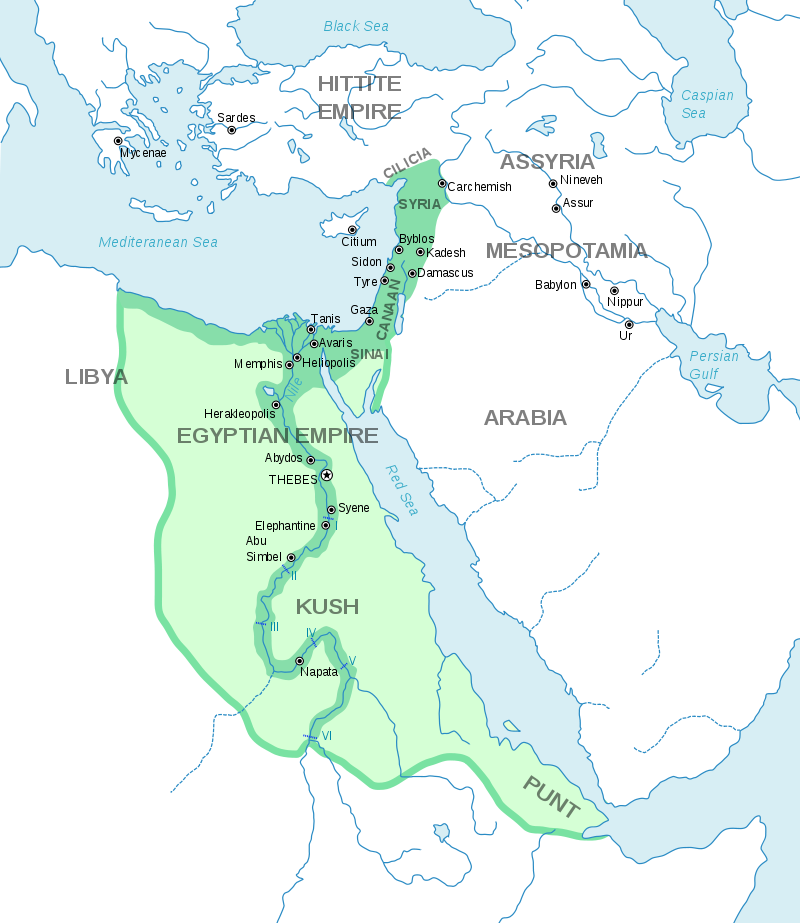
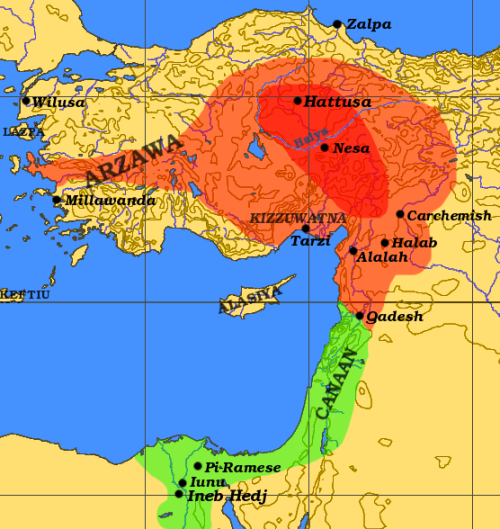
Green: The Egyptian Empire.  Red: The Hittite Old Kingdom. Orange: The extent of Hittite control.

Both Egyptian and Hittite interest in obtaining the coastal region of the Mediterranean saw many uneasy maneuverings (in the form of short-lived strategic treaties) as skirmishes between the two were not uncommon. To their east flank, whenever a Mitannian military unit appeared on the horizon, a marriage proposal would be offered by both greater powers, an offer that would curry favor and ensure an elevated status in such a way that flattered the king of Mitanni into neutrality in all matters, an effective deterrent in their sending any assistance of Egypt or Hatti over the other.

Thus intermarriages especially became commonplace toward the beginning of 15th century BC and was not merely exclusive between these three kingdoms. Letters during this century included an elaborate recounting of a Babylonian princess marrying into the Egyptian royal harem1.

The use of gold as a bargaining tool for bribery was another tactic of advanced statesmanship between sides in their respective courts. If a king rejected a gift of gold douceurs per se, reasoning that the presentation was too meagre an offer and taken as a slight. . . Well, that could very well be the means for the Hittites to attack the Egyptians and vice versa. By the same token, it could also buy temporary friendship between sides, which was rather more the customary outcome whenever gold was utilized in this fashion.

Well into Thutmose III's reign (1501-1447), on his twenty second year, he led his Egyptian army into a large scale invasion of Palestine, leaving the prince of Kadesh (Qadesh) and his allies to scramble together an ill-prepared and futile defense. News travelled quickly and was brought before the king of Assyria, and when Thutmose's legion eventually crossed the Euphrates, they were greeted with open arms and gifts, in the form of gold, silver, and lapis2.

After this exchange, the Egyptian king viewed Assyria favorably as evidenced by a certain cuneiform letter by an Assyrian man, Adadnirari, of which its text bears mention how Thutmose III had appointed his grandfather, Taku, as a chief to preside over an area known as Nukhashshi. The Egyptian king entrusted a foreigner with a position of power, the birth of a new concept:  Delegation.

At this point, Egypt's expansion claimed Halab (Aleppo) and Carchemish, and friendly relations from the empire were opened, using the successful interactions with Assyria as a reference point, and soon other nations began to accept to the absolute authority of Thutmose III. The Yezedis (Kurdish) were allowed to occupy the foothills between the two great rivers (Euphrates and Tigris) unmolested. Even the Hittites began to offer gifts suing for peace, for the reputation of Egypt's rule during 15th century BC was unquestionable and unmatched.


  1. Many pharaohs possessed a number of wives and courtesans, and the royal harem was not a place of disgrace in the public eye of the Egyptian people, much to the contrary, such an inclusion meant to be recognized as an official family member of the 18th Dynasty's ruler. To be among those within the royal harem implied a certain prestige and a mutual voice of power reserved only for those who dwelt within this modest collective.
  2. In Ancient History - Part 1 the Mitanni had absconded with the prized gold and silver gate of Ashur, Assyria's capital city. It can be easily understood how the Assyrians were spared from Thutmose III's wroth, yet the Mitanni were not. One hand would appear to wash the other and perhaps revenge was best served cold vis-à-vis with the blade and chariot of Assyria's new ally, the Egyptian conquerors.

Tuesday, August 1, 2023

Ancient History - Part 1: The Birth of an Empire


Let us travel back to 16th century BC . . .  Where the great lands of the civilized world were Egypt, Hatti (geographically: modern day Turkey; ruled by the Hattians, later the Hittites), Assyria, Babylonia (conquered and controlled by the Kassites by this time, remained known as Babylonia), and Elam (geographically: modern Iran). Of these five grand powers of the known ancient world, Egypt and Hatti rivaled near the top of the hierarchy, with Egypt in first as the power center of the Near East (what we now refer to as the Middle East). A very distant third, in terms of both military power and expansive trade, would have been Babylonia, but it was without doubt inferior in all aspects to the grander two empires above its station.

Assyria was in its infancy, and would later grow to a vast empire of its own right, but during this era was but a small state, well-protected but also isolated by the endless miles of unexplored rough terrain that surrounded its nation.

Egypt was coming off the heels of expelling the Hyksos (Asian invaders of unknown tribe or origin) and following this invaded the Semitic lands of Palestine and all the fertile grounds around them. Thutmose I pressed the might of his Egyptian military forces into Syrian lands and all the way to the Euphrates River.

Three hundred years prior, the Hittite ruler, King Murshil I, swept down from the hills of Taurus and took much of the lands of Syria, a culmination that bore witness to their taking over Aleppo. His freebooters sailed down the Euphrates to raid Babylonia, and historians debate whether or not such attacks were referenced in The Books of Chronicles in the Bible.

These attacks were the height of incursion on the part of the Hittites to Babylonian lands, for concern that too much force might expose their rear flanks to the forever-pending threat of an Egyptian invasion. Such were the political conditions and theater of war at this time.

Sharing in the western portion of their lands, the Assyrians were overshadowed in history by the strength of the Mitanni. So strong was this nation that their king, Shaushshatar, invaded Assyria's capital city, Ashur, and carried off its gate, fashioned from gold and silver and a structure of pride for the Assyrian people. Stolen, they thereafter erected it in the Mitanni capital, Washshukkani, as a trophy of Assyria's submission. This act of humiliation likely drew Assyria's ire for many forthcoming generations.

Throughout 16th century BC to 14th century BC, the Near East was engulfed by ongoing Syrian and Palestinian wars. However, the two nations of Assyria and Babylonia were prevented from taking part, largely due to two buffer zones. First, the brutish Mitanni lay directly north and west of the Assyrian people. Second, the desert east of Palestine separated Babylonia from its most direct route to the convergence of military campaigning.

Adding to this isolation, historians must also consider the geography. While the lands of Assyria and Babylonia lay to the east of the Euphrates, all of the action between Egyptian, Semitic, Hittite, and Mittanian forces fought for blood west of the great river. 

It is most interesting to note that while the Egyptian and Hittite empires exhausted time, resources, and lives in a state of perpetual mass warfare, youthful Assyria remained untouched, and thus became the genesis of its growth into a great empire, facing little resistance in slow expansion into uncontested northern lands, with an eye on the lands of Babylon to the south.