Showing posts with label Palestine. Show all posts

Wednesday, January 15, 2025

Ancient History - Part 60: Limited Rule For The Philistines


Despite the Philistine rule of the lower portion of the Levant region, the Hebrew religion remained unaffected by their influence. While the Philistine civilization drew heavily from their Aegean counterparts (as seen by their rebranding of Canaanite cities to Greco names), the invaders' very dominance over Palestine did not amount to much of anything in the way of changes to the Semitic culture. 

Upon the Philistine conquest of the five largest Canaanite cities Ekron, Askalon, Gaza, Ashdod, and Gath, each was left without a ruler, Gath being the sole exception. Within Gath was the seat of the king, who ruled the entirety of the Philistine Confederation. New towns were settled in the hillside surrounding these cities, primarily Philistine in makeup and origin though this was not to last as the populace soon intermingled.

Philistine rule was designed to dominate by force, militarily. Ironically distrustful of invaders, they viewed uncircumcised men and their brethren as unwelcomed visitors at best, and until king David would later rise to liberate his people, maintained a strangle-hold upon key areas in Judah and Israel.

The culmination of this repression of the Israelites by the Philistines resulted in war. At Ebenezer, a site in southern Palestine, two major battles took place between the Philistines and the Israelites. The Philistine warriors in full battle-regalia the first won against the Israelites, capturing the Ark of the Covenant. In the follow-up battle, the mercenary units of David, the Cherethites, made their presence known, winning the uprising king and his Israelites the day and their well-earned independence.

Nothing detracts more from a dictator's rule than a disinterested populace. In the case of the Philistine dominance over the Semitic peoples, it was less than two centuries for a rebellion to build and surmount an efficient effort of resistance.

When it comes to Palestine, historically speaking, rule over the the Semitic people always bears a limited shelf life, as their spirit to prevail in their fight for freedom proves them victors for thousands of years in whatever contests of attrition they are subjected to in order to survive.


[THE BATTLES OF EBENEZER]


Wednesday, January 8, 2025

Ancient History - Part 59: The Philistine Confederacy


Caphtor is frequently mentioned in the ancient inscriptions of Egypt and Syria as well as the Hebrew Bible and is purported to be the original homeland and locality of the Philistines. There is much discourse in the relation between the Cretans, Minoans, and Philistines in regards to Caphtor, as all three groups appeared to have occupied the region, at times simultaneously. 

Egypt commonly referred to those native born to Crete or Cyprus as Minoan and their migrant populations later recognized as Keftian. Both groups therefore migrated to Caphtor to adopt the lifestyle and ways of the Philistines who thereby ruled it. The language of the Philistine lands was maintained as Semitic, despite a continual influx of migrants who entered via Palestine’s coasts.

Upon the Philistines overtaking of Gaza City, the grand temple converted to worship their sea-god, Dagon, the very head of their pantheon. According to the Bible, the Philistine temples whose construction followed were massive in size and scope. They adopted the architectural design of the Babylonians and Egyptians, with the exception of leaving massive open theater areas that were commonly used for gladiatorial combats of amusement, especially in the case of the palaces.

Some of the ruthless sporting events included boxing and bull-grappling. Unlike sports of today, most outings comprised of participants forced to challenges resulting in death, much to the delight of the onlookers. Suffice it to say, the losers did not return home with their tails between their legs, in fact, they likely didn't return at all.

Beneath the roofs of these structures, heads numbering amongst a thousand or more could move freely within, whether gathered together for the purpose of worship, festivity, or political discourse. With the Cretan, Minoan, and Semitic peoples all dwelling in this region, it was well over a century that the Philistines enjoyed significant rule over the region until the rise of David and his Kingdom of Israel came to fruition.


[KEFTIAN CAPTIVE of Egypt during the 1200s BC]


Wednesday, December 25, 2024

Ancient History - Part 57: Slayers, Slavers, And Survivors


Not every tribe joined the Migrant Army. The Pulesati, for example, took one gander upon Egypt's fortifications and abandoned all cause to the multiconglomerate's land horde. This group instead chose to settle in Shepheleh, unclaimed land just outside of Palestine, where a century later found themselves at war with the Israelites, all of this supposedly referenced in the lost Book of Jasher.

Whilst the mighty empire of Egypt proved capable of repulsing these threats by land and sea, the Israelites were guaranteed no such safeguard. For centuries the Semitic people were subjected to being overrun and ruled by outsiders, first by the Hittites and Egyptians, and now extending to the Philistines, the Pulesati, and the Sea Peoples themselves.

Upon Egypt's defeat of the Sea Peoples (at the Battle of the Delta) and their Migrant Army (at the Battle of Djahy) the fates of many of the losing tribes varied. Two notable examples include:

  • The Washasha tribe was one of the legions that was captured and enslaved to Egypt, sentenced to lifelong servitude, in the form of hard labor.
  • A lesser known tribe, the Zakaray, disappeared for nearly a century before the last remnants of their civilization was found by Egyptian tradesmen, resettled in a field to the north.
Countless other tribes who fought amongst the Migrant Army are listed in the Harris Papyrus which heavily focuses upon these wartime events and documents the enemies of Egypt by name, though many are never referenced again in history, as they scattered and split apart into obscurity in the aftermath of the two battles.

The Sea Peoples successfully conquered many nations in their migration towards Egypt. Whilst the cultures of Syria and Israel survived, many other societies who lacked a system of commerce to serve up in offering, were eradicated mercilessly. Egypt and Israel's strengths by its people were not to cave to pressure, despite the seething array of threats by this foreign enemy. Whilst the power demonstrated by Egypt to defeat this opposition is the peak of the era's events, Israel's continued survival against overwhelming odds should not be overshadowed either.


[HARRIS PAPYRUS: Primary source for the events during Ramses III's reign]


Friday, November 29, 2024

Ancient History - Part 55: A Deeper Look Into The Sea Peoples


Let us take an introspective look upon when this troublesome mass migration from the westerners began, leading up to Egypt's successful battlefield engagements against them. The Pisidians who dwelt from Sagalassos along with the feather-crested battle-armored Lycians of Lycia and Carians of Caria (all geographically located throughout modern day Turkey) gathered and pushed southwestward.

According to Egyptian record, no land could stand against this massive horde, and upon their departure from Anatolia, one-by-one the Syrian city-states began to fall. There were two notable divisions amongst this threat to the Near East: 

The shipmen and the land-horde.

First it was Alashiya that was attacked, overrun by shipmen who assaulted from the sea. Upon victory, the migrant fleet next completely overtook the Syrian Gulf of Issus, permanently circling its coastline in its callous occupation. 

The land-horde however marched into Syria en masse. Arvad, Cappadocia, and of course the legendary historic city of Carchemish were not spared. These places of import, their beauty first desecrated, were largely destroyed by this land-horde, with many citizens likely losing their lives as foreign invasions of this nature rarely offer much in the ways of mercy.

The Amurru kingdom (Palestine) was next attacked and leveled, and it was here that the massive push was halted. We know what came next with the battles between Egypt and the Sea Peoples, but massive damage had been done to Egypt's subjects, and the Near East now bore a literal culture war on its hands between the native kingdoms and the invaders.

When you fear nothing, doubt is eliminated. If your enemies project weakness, then the time to attack is immediate. Thusly, the doubtless hordes of the west immediately attacked the Syrian princes, who'd in the past always relied upon the protections of either the Hittites or the Egyptians, themselves noticeably possessing no desire to fight. And it all fell apart. Trade was displaced and there was no preventing the trail that was blazed right through their land. 

This is not to overshadow the achievements of Egypt in defeating the Sea Peoples when it eventually came to thwarting direct attack, but if one thing can be ascertained about Ancient Egypt it is that defending her subjects was not one of her strengths, if the Upper Levant region is any indication.

[THE FORTRESS OF ARVAD]


Wednesday, October 23, 2024

Ancient History - Part 52: New Players In Town


Upon the collapse of the Hittite Empire, the former lands of her domain fell into the hands of the local princes and lords of the Levant region, most notably in the case of the Philistines, who up to that point began to settle in Palestine. The necessary documentation required for this era of recorded history for the events that followed relies largely upon Egyptian reports dating back to 1190 BC.

In addition to the Philistines, the Aegeans, or the Kleftians, as the Egyptians preferred to name the Mediterranean seafaring peoples, began to enter Asia Minor and colonize upon Cyprus and other uncontested coastal shores along Anatolia, Syria, and Lebanon. However contrary to ancient Egyptian presumptions, these were more than merely tribes migrating from what we know as modern day Greece, but tribes also originating from Crete, Sicily, Sardinia, and the rest of modern day Italy. Egypt lumped the "People of the Sea" as Greek in origin, but latter-day historians of the age of Great Britain have since matched the names of several deceased as varying all throughout the Mediterranean.

Egypt was firmly placed into the uncomfortable position of seeing foreigners pushing into the lands she once occupied, yet powerless to oppose the rapid changing of the times. New cultures would dominate and carve out boundaries to establish strong heterogenous states, while the empires of old, would follow into the footsteps of Hatta on the long downhill road towards decay.

Egypt's pharaoh, Ramses III thusly felt obligated to act against these new players in town, but the Philistines eagerly awaited this pending challenge, and his army was met and repulsed by a stalwart force of Philistine defenders. Upon defeating the once-great Egyptian power, the new migration seamlessly integrated vast swaths of territory, pathing the way for other tribes to follow. For the first time in centuries, the Semitic peoples were permitted to establish their own leadership to rule themselves, this valiant stand put on full display as a warning for any future would-be conquerors. 

The Achilles' heel to every empire is a loss on the battlefield to a lesser enemy for all to witness. One could argue that with the defeat of Egypt, the Philistines did not merely claim their independence, but signaled the end of Egyptian polity of the Near East, created by Thutmose centuries earlier, once and for all. 


[THE PHILISTINES as depicted by Egypt]


Wednesday, September 25, 2024

Ancient History - Part 48: The Trouble With Peace


[HITTITE VERSION OF PEACE TREATY]


The context in which the treaty between Egypt and Hatta was formed is a matter of great significance. Whilst the Hattic king lowered his tone to a level of warmth in regards to a peaceful effort of mutual partnership, be it border-defenses or curbing the migratory shifting of adjacent populations, Hattushil still dictated his kingdom's needs with a firm hand, particularly in the matters of territorial dispute. And so the first drafting of this peace treaty was composed from the Hatta camp, not Ramses's.

The finely carved letter of cuneiform arrived by horseback upon a silver platter once presented to the pharaoh. Ramses counter-drafted with overtures of his own, agreeing to Hatta's ownership of four-fifths of Syria, listing the specific towns and provinces included, and etched the compromise in metal before sending it back.

In the end, both parties agreed that the other's border would be rendered immune from invasion by the opposing side, with many Egyptian deities quoted by Ramses's scribesmen as honoring the agreement with their divine eyes. Hattushil in turn gave ceremony in the traditional Hattic religious custom (public temple prayer and demonstrations of stately worship amongst both soldiery and citizen alike) before returning to Ramses's draft with an addendum.

Hatta recognized Egypt's sole province in the Near East as Palestine and only Palestine. The entirety of lands within Syria's borders would endure Hatta's dominion. Each of Syria's princes were consigned as traveling witnesses to these discussions, pawns and figure-heads who gladhanded with their overlord and former overlord alike, and in the end, fully accepted Hattushil's and his successors' leadership in all matters of future governance.

The key to knowing which buttons to press during diplomatic negotiations can be tremendously difficult to ascertain. However, when two rivals war with the another for a lengthy number of years, one begins to know thy enemy as well as they might a third hand. Hattushil used the familiarity of his enemy to know what was too much and what was not enough. He rightfully gambled that rather than risking a war with Hatta and her knew ally, Babylonia, it was in the Empire of the Nile's best interest to approve what would otherwise be a lesser deal under previous circumstances.


[EGYPT'S VERSION OF PEACE TREATY]


Wednesday, September 18, 2024

Ancient History - Part 47: A Changing of the Guard


Egypt and Hatta continued to battle along their Syrian borderlands, where one such engagement claimed the life of Muwatallis. Sensing the void in leadership, Ramses II mustered three more armies and began to reinforce the frontlines in preparation for another full-scale invasion from the south. Upon a civil war that erupted between rival leaders in Hattusa, king Hattushil II (III according to some modern historians) emerged. His reign lasted a great many years.

While Egypt managed to plague the Hattic kingdom's forces, Hatta still managed not to lose much ground, and once Hattushill II had fully ascended to the throne, still possessed a sphere of influence that running from northern Syria to the topmost border of Palestine. This fertile area continued to fund the entirety of the Hattic kingdom as its chief source of revenue.

Ruling with a firm hand, Hattushil eliminated the question as to who controlled Syria, and despite their vast forces, the pending Egyptian invasion never arrived, the territorial lines once again respected by the two superpowers of Hatta and Egypt. 

Later, the Kassite king of Babylonia corresponded with Hattushil regarding the migratory shift of the Amorite population fleeing Hittite-occupied Syria into the desert with some even making their way into Babylonia. A man of surprisingly great eloquence, Hattushil II transformed from a fiery war chief to a charming elder statesman, and in a successful exchange managed to curb Babylonia's cautiousness, offer explanation that the movement of peoples was not intentional but rather a side effect of the war. In the end, the Hattic king gained a powerful new alliance in this unforeseen friendship with the superpower of the southeast, Babylonia.

Egypt then followed the footsteps on Babylonia, sealing an agreement of friendship, and a new peace treaty was actualized with Hatta.

Some battles are won not by the sword, but by the pen (or the chisel by what 1300 B.C.'s cuneiform standards would suggest) and Hattushil managed to do what years of blood-soaked violence could not. Simply treating with the rival power of Babylonia was enough to intimidate a peaceful result with Egypt thus demonstrating that while no monarch's rule is infallible, a simple change in leadership followed by immediate action is usually enough to gain the attention of all friend and foe.


[KING MUWATALLIS REMEMBERED upon his death]


Wednesday, September 11, 2024

Ancient History - Part 46: The Blood Feud Begins


King Murshil's reign exemplified a non-aggression principle with areas outside of his domain that were previously the aim of conquest by Hatta left largely untouched. Whether this was due to an ill-desire of placing his people in the proximity of the growing Assyrian peril or merely a touch of benevolence still remains unclear.

Murshil is estimated to have died roughly around 1300 B.C., upon which his son, Muwatallis, assumed the Hittite throne. Almost immediately, the new king found himself in open-conflict with the Egyptian king, Seti I, whose armies not only encroached upon Hattic territory, but violently clashed with that of his own. As Egypt pushed with northward marches, Hatta responded in southward counter-marches culminating in bloody skirmishes. The days of being honor-bound to a treaty forged by their forebears soon lay buried in the past.

Warbound enemies once again, in the eighth year of Egyptian-Hittite armed conflict, Seti I died and before the throne had time to even pass to his successor, the Hattic forces successfully broke through, assuming the recently deceased pharoah's rich provinces, in a deadly path through Egypt's dominion. The death of a monarch is an ill-omen, and typically signals enemy forces with a ripe opportunity to attack a weakened nation's heart.

However, once the Egyptian throne officially passed onto Ramses II, the landscape would change. Five years later, the infamous Battle of Kadesh took place (a topic deserving of an in-depth analysis of its own post(s) potentially at a later date) where both embittered overlords of Syria clashed in what has been cemented as a storybook highlight of Egypt's proud history. Fragments exist from both the Egyptian and Hittite perspective on how the events of that fateful day unfolded.

Kadesh was a Hattic controlled city and Ramses II set out to overtake it. The core armed strengths of both superpowers' militaries were bound to face-off in a deadly culmination at this battle site and various ploys and intrigues took place prior to, during, and after the battle itself. 

In the end, despite proclaiming courage and victory, Ramses II and his army's attack on Kadesh (Qadesh) was repelled, quickly pivoting to withdraw to Palestine. There were many close encounters for the pharaoh on the battlefield that nearly sent him to an early crypt, who insisted that he, along with his elite guard, be placed in a precarious mid-line position in order to inspire his troop amidst the fighting.

While the battle-hungry Egyptian leader technically lost, the resulting aftermath had the king of Egypt declared the victor, and this is a profound example of how the presentation of information can manipulate a people's attitude and favor when efforts are made to obscure detection of the deceit. Ramses II's reign would continue many more years, some still in conflict with the Hittites, and yet that loss is still touted as a victory in some circles of Egypt's cultural heritage even to our present day. 


[KING RAMSES II, as depicted in battle]


Wednesday, August 28, 2024

Ancient History - Part 44: An Empire At Its Peak


Upon the defeat of prince Aki-izzi's league of Semitic and Harri rebels, Shubbiluliuma next turned his conquest toward central Syria, occupied and controlled by the Amorites. Much like northern Syria had Aleppo as its crown jewel, central Syria bore Kadesh, the most prestigious power center of the region, and the Hattic king reasoned that should it fall, the surrounding areas would be quick to follow. A theory that proved correct.

With the success of his Campaign of Syria thus far and central Syria fallen, Shubbiluliuma knew that there were greater riches extending beyond Syria, whose resources were quite matched in wealth and would see grand results in the eventual trade from it that would follow the war. The most fertile lands that he eyed with a hunger, lay southward, the lands of Aziru (Lebanon) and Palestine, specifically.

Syria, Aziru, and Palestine are collectively known as the Fertile Crescent, an area desired throughout history by many competing powerful kingdoms.

According to the Amarna letters, Shubbiluliuma's forces overwhelmed and defeated the remaining Amorite regions of Syria with ease, but once it came time to annex Aziru, were met by a fiercely unexpected resistance. Be it city-street or countryside, the defenders, though few, simply would not surrender. Despite his heightened interest in conquering the former Egyptian-satellite nations, upon Aziru's eventual submission (and compliance to a heavy monthly tribute that would lessen over time), the Hattic king ended his conquest here.

In the aftermath of the Hittite Empire's violent expansion, two empires now encroached upon the other. Hatta and Egypt. This was a most sensitive political situation and the first instance in a span of many years when two superpowers of the Near East directly bordered the other in such a confrontational manner.

The Hattic king treated with the Egyptian Pharoah and the battlefield changed from a clash of swords to a conversational war of words. Perhaps heated at first, in the end, Shubbiluliuma and Amenhotep III signed a peace treaty. Hatta would retain control over Aziru whilst Egypt would retain control over Palestine, and neither empire would take arms against the other, as far as both monarchs ruled.

And while all agreements prove temporary over time, neither side challenged the limit of the treaty, with much to gain from mutual obeyance. The Hittite forces bore wartime exhaustion and the Egyptian empire was in a state of rapid decline which extended to the waning size and scope of their once mighty military. For a lengthy period, the security measures were respected by both nations, peace terms held intact.


[LETTER BETWEEN EGYPT AND AZIRU]


Wednesday, August 14, 2024

Ancient History - Part 42: Hail To The King


After defeating Hanigalbat and her Mitanni, Shubbiluliuma returned to Syria with his soldiers to attack the last holdout, Aleppo, whose level of national will kept the prince's city independent up until that point. But Shubbiluliuma's army had grown so large compared to his early raids upon Syria, that this time, they'd little opposition and marched right into the heart of the city. Whether by means of migration or war, the nations of the Near East has a history of knowing no borders, nor the concept of freedom for other peoples.

With both rivals (Egypt & Hanigalbat) removed, Shubbiluliuma continued to conquer and impose his imperial rule over Syria in many steps:

  1. Kingdom of Niy: A largely Semitic population bordering southern Hanigalbat, a regional prince, Shutatarra, refused Shubbiluliuma's offer to show allegiance. Thus, the son, Aitakkama, killed his father (much in the same manner as the Mitanni king was slain by his own) and became a loyal agent to the Hattic king. Aitakkama actually led the attacks for Shubbiluliuma upon the Mitanni, with many successful raids persisting against Tushratta's successor.
  2. Tunip: A once Egyptian territory was taken by the Hittites, and the labors of the farms and fisheries spread to the benefit of the Hattic kingdom. Decadence and fear had spread across Egypt, weaknesses Shubbiluliuma sensed and correctly predicted no significant retaliation.
  3. Province of Kilis: The regional prince, Sharrupshi, remained loyal to his Egyptian suzerain, but that all changed once Aleppo fell. Just neighboring Aleppo at the northwest, rather than repeat the cycle of violent sieges for his cities to endure, he'd signed a treaty, bowing down his region to the Hattic king.
  4. Lebanon: This wealthy swath of land's Egyptian/Mitannian overlords had abandoned this region and rather than taste freedom, the Semitic peoples traded one familiar group of overlords for unfamiliar new group.

The Hattic king effectively disseminated the elite feudal-style ruling system that Egypt had set-up over Palestine, Lebanon, and Syria and quickly replaced the old with the new, inserting their own people as the ones bearing the whip. Whilst not making it as far as Palestine (still under Egyptian control) Shubbiluliuma still pushed against against defenses for as long as he could.


[SIGNED TREATY - Between Sharrupshi and Shubbiluliuma]


Sunday, September 3, 2023

Ancient History - Part 4: Uneasy Peace


Despite peaceful relations with Assyria and Babylon, Egypt mounted a continuous Palestinian campaign. Under the rule of Amenhotep II (1447-1420), the empire of the Nile quelled any civil unrest, amongst the rebellious Semitic people, before moving its armies back into the lands of Syria. While this march was no more than a nominal success, the Mitanni (the westward neighboring state to Assyria) suffered great losses which resulted in a significant displacement of their power and people. So much harm did the Mitanni sustain, that it left them in no other position than to plead for the mercy of Ra's chosen people.

Amenhotep II's successor, Thutmose IV (1420-1411), believed that if the Mitanni could be cooed into friendly terms, much like Babylon and Assyria, there was untapped potential in securing a third subordinate ally. Therein lay the predicament: The king of the Mitanni, Artatama I, was already fiercely befriended and trusted by the Hittites, the chief rival of Egypt. Even though by mid-15th century B.C., war between the Egyptians and the Hittites had been generally reduced to mild skirmishes (upon Syrian soil), tensions continued to boil, and each passing day both sides expected grand-scale battle to resume.

The Egyptian king thusly proposed a royal marriage between kingdoms. Thutmose IV would marry Artatama's daughter, a symbol of protection, one that accompanied the trust that Egypt would harbor no further attack upon the Mitanni any longer, but such a promise would warrant a step even further. Egypt allowed the Mitanni to enter the fold of its vision. With a single marriage, a shockwave rumbled throughout the Near East. The Mitanni's allegiance officially shifted from the Hittites to the Egyptians.

This new development did not rest easily with the two nations of Assyria (ruled by Ashur-bel-nisheshu) and Babylon (ruled by Kara-indash). Unlike his predecessors, for Thutmose IV, the Mitanni were now quickly becoming the Egyptian king's his favored state, or so it appeared.

The two rulers east of the Euphrates agreed upon one thing: Despite any ill-bearing or mistrust they'd once harbored for the other, it must all be set aside, in order to form a united defensive front, should any attack, no matter whom the would-be conquerors be, be led. 

Assyria began refortifying its towns and their city of Ashur, strictly insuring that no weak points existed amongst the battlements. Meanwhile, the Kassites of Babylon were in a state of constant patrol along the borders. 

However, these expectations of a pending defensive war were all for not. Thutmose IV passed away (1411) and his successor, Amenhotep III (1411-1375), immediately sent envoys to treat with Babylon and Assyria. This new king made his intentions well-known; he possessed no desire to expand into the northern mountains of Assyria nor the vast lands eastward into Babylon. He'd admired their nations as loyal subjects and wished to maintain a focus wholly upon the true sources of Egypt's discontent, the unending Palestinian and Syrian wars, respectively.

Amenhotep III's assurances did not go unchallenged by both Ashur-bel-nisheshu and Kara-indash, and when pressed for further explanation, he convinced them that the Egyptian people were a culture well-conditioned to the dry lands of the desert heat. They were not groomed for a cold wintry life in the mountains, pacifying the argument justifying Assyria's fear of the Egyptians as would-be conquerors of their land. When it came to Babylon, Amenhotep stated that the Euphrates River was an unmistakable natural boundary, and officially declared that Egypt would never expand beyond it.

At the conclusions of these entreaties, all sides departed. Satisfied.

Sunday, August 6, 2023

Ancient History - Part 2: Tributes & Tribulations


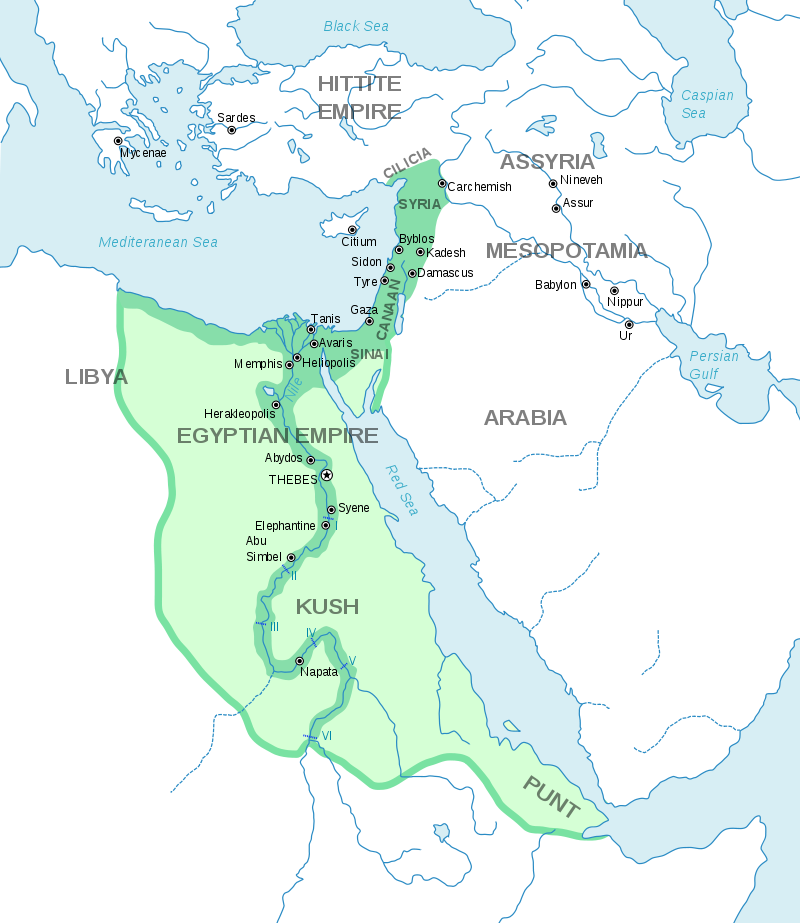
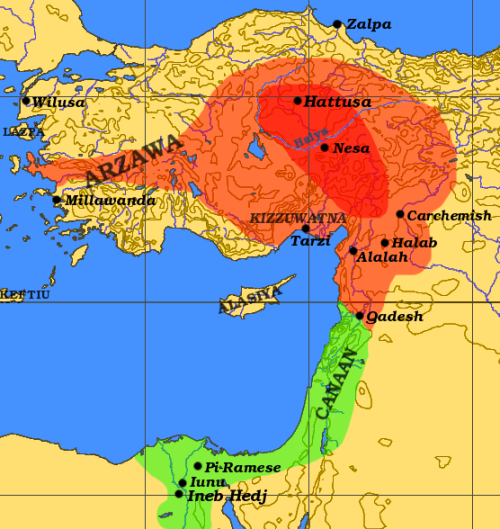
Green: The Egyptian Empire.  Red: The Hittite Old Kingdom. Orange: The extent of Hittite control.

Both Egyptian and Hittite interest in obtaining the coastal region of the Mediterranean saw many uneasy maneuverings (in the form of short-lived strategic treaties) as skirmishes between the two were not uncommon. To their east flank, whenever a Mitannian military unit appeared on the horizon, a marriage proposal would be offered by both greater powers, an offer that would curry favor and ensure an elevated status in such a way that flattered the king of Mitanni into neutrality in all matters, an effective deterrent in their sending any assistance of Egypt or Hatti over the other.

Thus intermarriages especially became commonplace toward the beginning of 15th century BC and was not merely exclusive between these three kingdoms. Letters during this century included an elaborate recounting of a Babylonian princess marrying into the Egyptian royal harem1.

The use of gold as a bargaining tool for bribery was another tactic of advanced statesmanship between sides in their respective courts. If a king rejected a gift of gold douceurs per se, reasoning that the presentation was too meagre an offer and taken as a slight. . . Well, that could very well be the means for the Hittites to attack the Egyptians and vice versa. By the same token, it could also buy temporary friendship between sides, which was rather more the customary outcome whenever gold was utilized in this fashion.

Well into Thutmose III's reign (1501-1447), on his twenty second year, he led his Egyptian army into a large scale invasion of Palestine, leaving the prince of Kadesh (Qadesh) and his allies to scramble together an ill-prepared and futile defense. News travelled quickly and was brought before the king of Assyria, and when Thutmose's legion eventually crossed the Euphrates, they were greeted with open arms and gifts, in the form of gold, silver, and lapis2.

After this exchange, the Egyptian king viewed Assyria favorably as evidenced by a certain cuneiform letter by an Assyrian man, Adadnirari, of which its text bears mention how Thutmose III had appointed his grandfather, Taku, as a chief to preside over an area known as Nukhashshi. The Egyptian king entrusted a foreigner with a position of power, the birth of a new concept:  Delegation.

At this point, Egypt's expansion claimed Halab (Aleppo) and Carchemish, and friendly relations from the empire were opened, using the successful interactions with Assyria as a reference point, and soon other nations began to accept to the absolute authority of Thutmose III. The Yezedis (Kurdish) were allowed to occupy the foothills between the two great rivers (Euphrates and Tigris) unmolested. Even the Hittites began to offer gifts suing for peace, for the reputation of Egypt's rule during 15th century BC was unquestionable and unmatched.


  1. Many pharaohs possessed a number of wives and courtesans, and the royal harem was not a place of disgrace in the public eye of the Egyptian people, much to the contrary, such an inclusion meant to be recognized as an official family member of the 18th Dynasty's ruler. To be among those within the royal harem implied a certain prestige and a mutual voice of power reserved only for those who dwelt within this modest collective.
  2. In Ancient History - Part 1 the Mitanni had absconded with the prized gold and silver gate of Ashur, Assyria's capital city. It can be easily understood how the Assyrians were spared from Thutmose III's wroth, yet the Mitanni were not. One hand would appear to wash the other and perhaps revenge was best served cold vis-à-vis with the blade and chariot of Assyria's new ally, the Egyptian conquerors.