Showing posts with label Mitanni. Show all posts

Wednesday, October 2, 2024

Ancient History - Part 49: The Lion In The Room


Surprisingly, Carchemish was left off the Treaty of Kadesh. This has to led to some speculation that either a non-Hittite entity (such as Assyria) had absorbed the city during the negotiations between Hatta and Egypt, or more likely, Carchemish had already become a recognized part of king Hattushil's home capital, thereby needing no such formally written recognition in the agreement.

During this period, Shalmaneser I, the king of Assyria, had reached the Middle Euphrates, with his armies frequently setting raids from across the water. The target of these raids primarily included Hatta's ally, the Mitanni, who sustained the brunt of these attacks, and included their capital, Hanigalbat. Thusly, it is not unreasonable to put Assyrian occupation of Carchemish outside the realm of possibility here.

Whilst previously Egypt was frantic to accept swift Hattic friendship due to pressure from their alliance with Babylonia, it was soon the Hittite people's turn to ask the same of their former enemy. As westward expansion by Assyria encroached upon their lands, Hattushil drew upon letters to Babylonia and Egypt both, reporting aggressive movements of this powerful new threat. However, as we know, not much was done in the manner to curb the Hattic king's worry.

Even still, thirteen years after signing the Treaty of Kadesh, Hattushil concentrated on fulfilling strategic maneuvers to strengthen the bonds with his allies, and began by marrying one of his daughters to Egypt's pharaoh, Ramses, who would join his Royal Harem. The correspondence at this junction actually included Hattushil's queen, Pudukhipa, directly addressing matters concerning her daughter and the Egyptian lifestyle, and also Ramses asked for large supplies of smelted iron from his new kingly friend.

Generally speaking, it is very difficult to create a reasonably sized conglomerate of allied nations to defend against the level of danger that the war-hungry Assyrian army posed to the rest of the Near East. Egypt and Babylonia did not appear to treat this threat with the same manner of heightened care that Hatta did, and instead demonstrated clumsy foresight by the hands of Babylonia's king, and an agnostic interest at best on behalf of Egypt's, due to distance.

It's a reasonable basis in hindsight that the Hittites and their king were correct in fearing Assyrian expansion, but unfortunately their voices were drowned out in a sea of disinterest, a price all players with the exception of perhaps Elam, in the far east, would later pay at a supreme cost.


[KING HATTUSHIL II]


Wednesday, September 4, 2024

Ancient History - Part 45: The Syrian Principalities


The Hand of Nergal, a deadly plague, engulfed the lands of the Hittites, and by 1360 B.C. king Shubbiluliuma had fallen ill and died. His firstborn son and heir, Arnuwandash, too, succumbed and passed, thus the kingship was left to Murshil, Shubbiluliuma's second son and sole remaining male heir. Murshil's constitution prevailed and he soon ascended to the throne.

The first decade of Murshil's reign focused primarily on visits throughout Syria and engagements with local matters of state. There are several references etched upon cuneiform, recovered from Bogazkale, detailing the princes of Syria treating with the new king. Carchemish (Karkemish) appeared to be the most favorable amongst his subjects, though Aleppo (Alep) proudly reminded its citizens of their friendship with the ruler of Hatta.

Securing warm relations with his freshly conquered subjects was a matter of deep importance to Murshil, though in the case of Kissuwadna, vast effort was required. Shubbiluliuma severely chastened the prince and his people, but agreed to allow the city its autonomy if an alliance was drawn that Hatta's allies and enemies would be mirrored by Kissuwadna. After much deliberation, assurances were made and the city's loyalty and its alliance to Hatta remained intact with this younger king.

Following their betrayal, the Harri had scattered to the winds, relocating to various Syrian cities, and the wiser princes promised that should Murshil require reinforcements in future-wars, the Harri populace would be the first lines of enlistment. Murshil retained the friendship of Syria by agreeing to abolish the frontier fortifications that separated the border-states, especially now that his father's campaign against them had ended.

Lastly, outside of Syria and Hattic territory, Murshil adopted his late-father's stance toward the Mitanni. He understood the value placed on their continual existence as a buffer-state between Hatta and Assyria. As Assyrian power grew and threatened all that touched its ever expanding borders, an attack on the Mitanni would act as an alarm system, signaling danger to the greater Hittite state. Thusly, Murshil warranted that the Mitanni people would be permitted freedom to dwell and use the Tigris and the riverlands around it as their own.

A back door is a security flaw designed to directly admit the safe passage to the creator and by maintaining an ally with the Mitanni, it was a strategy that meant that the Hattic king could theoretically move an army through Hanigalbat lands to strike at a growing enemy, should the need arise, particularly, an Assyrian enemy.


[MURSHIL'S PRAYER TO THE GODS TO END THE HAND OF NERGAL]


Wednesday, August 21, 2024

Ancient History - Part 43: The Last Redoubts


[SYRIA=YELLOW: THE LANDS OF SHUBBILULILUMI'S CONQUEST]


As Shubbiluliuma asserted his dominance over northern Syria, the remaining of independent regions fought tooth-and-nail in defiance:

  • Shaizar and Rukhizzi: Twin settlement communities of towns and common folk. There was little in the way of military activity here, but the lands were no less rich, and the Hattic army took them with ease to supply the major war efforts of the much more defensible regions that lay south.
  • Abina: A small province full of Mitanni loyalists, thought to be located on the eastern border of Syria. After a crushing engagement in the field, Abina narrowly avoided a Hattic raid, sending messengers to greet their would-be invaders, signaling a willingness in shifting allegiance. 
  • Qatna: A Semitic state, harboring a people who despite small numbers, may have proven themselves the most heavily resistant challenge. Rather than relinquish liberty for the call of safety, the prince, Aki-izzi, openly maintained independence, at one point even calling upon Egypt's Pharoah, Amenhotep IV, for support. (Predictably, such pleas were ignored and prince Aki-izzi's people waited for a Hattic attack that never arrived. Shubbiluliuma instead left Qatna to be taken lastly, intending to appeal to the prince and his people's surrender only after the entirety of its neighboring region had been conquered)
  • Kinza: A populous state worth noting that whilst successfully repelling invaders, switched sides none too long thereafter. The ruling prince, Shutatarra, and his refusal to submit to Hittite authority was then ousted by his son, Aitakkama, and his new regime. In an interesting development, Aitakkama of Kinza became a close friend and ally to Shubbiluliuma, and was instrumental in carrying out his new king's will as the growing Hittite Empire's leading agent.
  • Aleppo: The king of the Hittites amassed the bulk of his forces in the Kowaik basin where he subjected the grandest city of Syria to a large-scale siege, clashing against Aleppo's defenders within the city's walls, well-armed Mitanni legions. Upon victory, Shubbiluliuma installed one of his own sons to the city's seat, to establish order whilst ruling in his name.

Once Syria had wholly fallen, Shubbiluliuma turned back to Qatna. However, his desire to appeal to prince Aki-izzi with reason was met with a disastrous discovery: 

The prince had secretly engaged in a successful conspiracy in spurring a fire within the ancestral rivals of Hatta, the Harri people, to defect, stoking a revolt within the Hittite army. Perhaps a less sane ruler might have reacted emotionally, but recognizing an opportunity, Shubbiluliuma enlisted his new ally, Aitakkama, and his forces to prove themselves, who defeated the prince and his assortment of local chiefs and traitors in battle, allowing the last redoubt, Qatna, to be annexed.

Despite the interference and setbacks that occurred, Shubbiluliuma's lengthy Campaign of Syria was a profound success.


[ALEPPO CITADEL - THE SITE WHERE MITANNI DEFENDERS WERE OVERTAKEN BY HATTIC FORCES]


Wednesday, August 14, 2024

Ancient History - Part 42: Hail To The King


After defeating Hanigalbat and her Mitanni, Shubbiluliuma returned to Syria with his soldiers to attack the last holdout, Aleppo, whose level of national will kept the prince's city independent up until that point. But Shubbiluliuma's army had grown so large compared to his early raids upon Syria, that this time, they'd little opposition and marched right into the heart of the city. Whether by means of migration or war, the nations of the Near East has a history of knowing no borders, nor the concept of freedom for other peoples.

With both rivals (Egypt & Hanigalbat) removed, Shubbiluliuma continued to conquer and impose his imperial rule over Syria in many steps:

  1. Kingdom of Niy: A largely Semitic population bordering southern Hanigalbat, a regional prince, Shutatarra, refused Shubbiluliuma's offer to show allegiance. Thus, the son, Aitakkama, killed his father (much in the same manner as the Mitanni king was slain by his own) and became a loyal agent to the Hattic king. Aitakkama actually led the attacks for Shubbiluliuma upon the Mitanni, with many successful raids persisting against Tushratta's successor.
  2. Tunip: A once Egyptian territory was taken by the Hittites, and the labors of the farms and fisheries spread to the benefit of the Hattic kingdom. Decadence and fear had spread across Egypt, weaknesses Shubbiluliuma sensed and correctly predicted no significant retaliation.
  3. Province of Kilis: The regional prince, Sharrupshi, remained loyal to his Egyptian suzerain, but that all changed once Aleppo fell. Just neighboring Aleppo at the northwest, rather than repeat the cycle of violent sieges for his cities to endure, he'd signed a treaty, bowing down his region to the Hattic king.
  4. Lebanon: This wealthy swath of land's Egyptian/Mitannian overlords had abandoned this region and rather than taste freedom, the Semitic peoples traded one familiar group of overlords for unfamiliar new group.

The Hattic king effectively disseminated the elite feudal-style ruling system that Egypt had set-up over Palestine, Lebanon, and Syria and quickly replaced the old with the new, inserting their own people as the ones bearing the whip. Whilst not making it as far as Palestine (still under Egyptian control) Shubbiluliuma still pushed against against defenses for as long as he could.


[SIGNED TREATY - Between Sharrupshi and Shubbiluliuma]


Wednesday, August 7, 2024

Ancient History - Part 41: The Two Betrayals


King Tushratta of the Mitanni was no easy opponent, winning a great many of the initial engagements against the invading Hattic forces. For the entirety of his reign, Tushratta and his people were staunch loyalists to the Egyptian crown, and he reasoned that if his kingdom could demonstrate vigilance in the face of those who sought to destroy them, the Kingdom of Nile would surely embolster his defending nation.

Egypt, as we know however, was on the decline, and did anything but reinforce her Mitannian allies. Not only did the ill-prepared Egyptian forces fail to assist the Mitanni, but retreated from their occupied Syria soils at the first sightings of the Hattic enemy. Thus, despite winning on the field, king Tushratta ordered a tactical retreat back to his seat within Washukanni, the capital city of Hanigalbat that sat on the embankments of the Euphrates.

The king of the Mitanni dispelled any false notions of Egyptian rescue, for many months hearing from a distance how the Hattic army ravaged his land. Upon a brief deliberation, Tushratta recognized that his communication with Egypt was cutoff entirely, and was forced to consider suing for peace with Shubbiluliuma, rather than risk further annihilation. But the proud king was not to be swayed, this was a violation of property that he refused to throw out due to fear.

But the growing sentimentalities amongst his followers had morphed into dissension, and whilst his fighting spirit was undoubtedly hinged on the shoulders of honor and duty, a rebellious new faction was formed. This very faction, led by his own son Artatami II, betrayed the king, and the son violently slayed the father within his own palace walls, by way of razor, thus usurping the throne.

Hanigalbat then submitted to king Shubbiluliuma as overlord and by the time Tushratta's successor, Mattiuaza, assumed the throne, his entire kingdom was overrun by the Hittites of the west followed by the Assyrians of the east.

What strong leaders sometimes fail to recognize is that the the standard to which they hold themselves to does not necessarily apply to others. Tushratta reasoned that together with Egypt, they would expel the Hattic enemy, completely blind to the possibility of Egypt acting in cowardice. His capital stronghold being situated on an everflowing river, where he fortified knowing Washukanni impenetrable, could outlast the invasion. And yet his treacherous supporters and family murdered him.

History would have played out so very differently had only Tushratta simply continued to fight and trusted no one, holding true to the abilities of his own leadership and desire for his nation to remain independent.


[METHOD OF COMMUNICATION BETWEEN HANIGALBAT AND EGYPT (Amarna Letter, above)]


Wednesday, July 31, 2024

Ancient History - Part 40: The Banners Are Raised


While his intention may have been only to conquer and control northern Syria, Shubbiluliuma found himself in a rare strategic position. This new territory allowed access to even greater parts beyond the Euphrates to the east. And so, he consulted with the relocated Harri, of whose new land he'd now broach to cross, and these riverfolk banded together to join the favored king in battle as brothers once more.

For their participation, the levies against the Harri had been lifted, and the enlarged army crossed the Euphrates and into the lands of the Mitanni in a grand scale attack, first entering and overtaking Ishuwa, a prized area previously eyed by his predecessor, Hattushil. But the Hattic army did not stop there, moving next into Alshe, the adjacent province, and soon threatened encroachment upon the heart of the Mitanni kingdom.

King Tushratta of the Mitanni, tied directly to the Egyptian throne by marriage (brother-in-law to Amenhotep III) raised his banners and set to meet Shubbiluliuma's invaders in the field. In response, the king of Carchemish (unnamed thus far by historic record) of Syria, joined his forces to the invading Shubbiluliuma's, gaining favor above his fellow princes. Records do show however that Carchemish in the many years to follow would have direct Hittite bloodlines, hinting that this Syrian city-state did indeed become the favored nation amongst the Hattic king's new allies.

Reenforced by both auxiliary armies of the Harri and now the soldiers of Carchemish, the inevitable drumbeat began to sound as the Hattic forces neared their first massive battle with the Mitanni, led by Tushratta. The call by the defending forces' king beckoned that every last man must ride or die, their freedoms to perish along with any resulting failure. Their security threatened, both proud leaders set their sights upon the dawn in a prelude of their inevitable confrontation.


[IMPERIAL SEAL OF THE MITANNI]


Wednesday, July 24, 2024

Ancient History - Part 39: War and Peace


[A united Hattic Kingdom under Shubbiluliuma]


Shubbiluliuma removed the Harri people from Kissuwadna, confining them to the other side of the Euphrates, where they adopted the lifestyle of riverfolk. In the days that followed, the Hattic king's favorable treatment earned their obedience. The fatal mistakes that monarch-kings often make tend to be leaving problems unsolved, ones that continue to fester, and Shubbiluliuma's handling of Harri in a way that did not result in mass genocide or civil war was something the world took note of.

Next, he traveled to Syria to treat with the princes who ruled from their impressively rich city-states. This entire area bore spheres of influence that included princes aligned with the Mitanni and others with Egypt. In the case of the Mitanni, the Syrian princes were offered protection; with Egypt, innovation; but in the case of Hatta? War.

Shubbiluliuma did not enter Syria with peaceful intentions and carried the near full force of his armies into their lands. The Hattic king wisely chose to leave his internal struggles almost bloodless, but the opposite was true for the external challenge of staking a claim in Syria to form a new dynasty under his one rule. This move was unprecedented and a brutal one, taking Syria itself, along with its new allies in the Egyptians and Mitanni, completely unawares.

It is a fool's bargain to believe in others blindly fighting your battles for you upon nothing more than their word, and when the Hattic soldiers began their raids, Egypt and Mitanni occupied areas also fell to Shubbiluliuma's grasp. The local chieftains quickly submitted and before the Near End knew it, the Hattic nation now possessed all of northern Syria. King Shubbiluliuma's people remembered the old days written and told via oral tradition of the fierceness of the Assyria, and establishing this foothold in upper Syria was considered an effective posture against any notion of western expansion.

Just as one country might absorb another in order to create a buffer of sorts, this was the will of Shubbiluliuma's people, however, his own two reasons were entirely different.

Legacy and power.


[THE DEEDS OF SHUBBILULIUMA]

Sunday, September 3, 2023

Ancient History - Part 4: Uneasy Peace


Despite peaceful relations with Assyria and Babylon, Egypt mounted a continuous Palestinian campaign. Under the rule of Amenhotep II (1447-1420), the empire of the Nile quelled any civil unrest, amongst the rebellious Semitic people, before moving its armies back into the lands of Syria. While this march was no more than a nominal success, the Mitanni (the westward neighboring state to Assyria) suffered great losses which resulted in a significant displacement of their power and people. So much harm did the Mitanni sustain, that it left them in no other position than to plead for the mercy of Ra's chosen people.

Amenhotep II's successor, Thutmose IV (1420-1411), believed that if the Mitanni could be cooed into friendly terms, much like Babylon and Assyria, there was untapped potential in securing a third subordinate ally. Therein lay the predicament: The king of the Mitanni, Artatama I, was already fiercely befriended and trusted by the Hittites, the chief rival of Egypt. Even though by mid-15th century B.C., war between the Egyptians and the Hittites had been generally reduced to mild skirmishes (upon Syrian soil), tensions continued to boil, and each passing day both sides expected grand-scale battle to resume.

The Egyptian king thusly proposed a royal marriage between kingdoms. Thutmose IV would marry Artatama's daughter, a symbol of protection, one that accompanied the trust that Egypt would harbor no further attack upon the Mitanni any longer, but such a promise would warrant a step even further. Egypt allowed the Mitanni to enter the fold of its vision. With a single marriage, a shockwave rumbled throughout the Near East. The Mitanni's allegiance officially shifted from the Hittites to the Egyptians.

This new development did not rest easily with the two nations of Assyria (ruled by Ashur-bel-nisheshu) and Babylon (ruled by Kara-indash). Unlike his predecessors, for Thutmose IV, the Mitanni were now quickly becoming the Egyptian king's his favored state, or so it appeared.

The two rulers east of the Euphrates agreed upon one thing: Despite any ill-bearing or mistrust they'd once harbored for the other, it must all be set aside, in order to form a united defensive front, should any attack, no matter whom the would-be conquerors be, be led. 

Assyria began refortifying its towns and their city of Ashur, strictly insuring that no weak points existed amongst the battlements. Meanwhile, the Kassites of Babylon were in a state of constant patrol along the borders. 

However, these expectations of a pending defensive war were all for not. Thutmose IV passed away (1411) and his successor, Amenhotep III (1411-1375), immediately sent envoys to treat with Babylon and Assyria. This new king made his intentions well-known; he possessed no desire to expand into the northern mountains of Assyria nor the vast lands eastward into Babylon. He'd admired their nations as loyal subjects and wished to maintain a focus wholly upon the true sources of Egypt's discontent, the unending Palestinian and Syrian wars, respectively.

Amenhotep III's assurances did not go unchallenged by both Ashur-bel-nisheshu and Kara-indash, and when pressed for further explanation, he convinced them that the Egyptian people were a culture well-conditioned to the dry lands of the desert heat. They were not groomed for a cold wintry life in the mountains, pacifying the argument justifying Assyria's fear of the Egyptians as would-be conquerors of their land. When it came to Babylon, Amenhotep stated that the Euphrates River was an unmistakable natural boundary, and officially declared that Egypt would never expand beyond it.

At the conclusions of these entreaties, all sides departed. Satisfied.

Thursday, August 10, 2023

Ancient History - Part 3: The Babylonian Question


Once friendly relations were firmly established with Thutmose III's powerful Egypt, Assyria turned southward to Babylonia. Other than the Mitanni, who once rattled their borders with oppressive raids prior to Egypt's intervention, Babylonia, as ruled by the Kassites, was the nearest neighboring civilization. Following Egypt's grand conquest of the Near East's coast and strategic areas within the Mesopotamia, now was the perfect opportunity for the Assyrian king, Puzur-Ashur IV (1486-1460 B.C.), to address the Babylonian Question.

Would it be peace or war?

The Egyptians had seen fit to allow resident countries to preside over agreed upon boundaries as long as they continued to pay tribute (taxes) in the form of goods and precious rocks and metals used for what passed as currency at that time. How these different peoples interacted with one another was an entirely separate matter.

Not much is known of Puzur-Ashur's reign of Assyria, other than a few short pieces of note:

  • He restored the temple of Ishtar, which one might surmise was thoroughly desecrated at the hands and ill-treatment by their immediate neighbors, the Mitanni, though this is unconfirmed. At present, historians have it on record that the temple did fall into a state of decay and he'd restored it back to its once pristine condition, no less fit for Assyria's chief place of reverence.
  • While no major battles or wars are accounted for during his lifetime, the Assyrian king did commit strenuous efforts and time dedicated to the building of a new defensive structure, a protective wall for Ashur, their capital city, that would shield the newer southern districts that their growing population had rapidly expanded into, a much needed response to any outside danger.
  • But perhaps his grandest recorded accomplishment was the negotiations with the Kassite ruler of Babylon, Burna-Buriash I (1461-1436), where the two met and agreed upon establishing the precise borders between their respective kingdoms. Assyria already carried the experience in such negotiations with the Egyptian empire, that in this case, found themselves as leading the way as opposed to following, and as it was between Thutmose III and Puzur-Ashur IV, it was with Puzar-Ashur IV and Burna-Buriash I.

For the many years that followed, there was a prolonged period of peacetime amongst kingdoms and empires. At one point Burna-Buriash I's successor, Kurigalzu II (1435-1411), was invited by the Canaanites to wage war against Egypt, with a promise of a piece of the Semitic lands that they were so desperately yearning to liberate. To this, Kurigalzu declined, and each of his successors were continually solicited to turn against the great empire of the Near East. Just as their forbearer once demonstrated, each Babylonian ruler also declined, referring to the Egyptian pharaoh as "my brother."

The Egyptians had established dominance for this century (15th century B.C.) by making friends where enemies might once had surfaced. However, as history will often remind, nothing lasts forever, especially in the case of the status quo.

Sunday, August 6, 2023

Ancient History - Part 2: Tributes & Tribulations


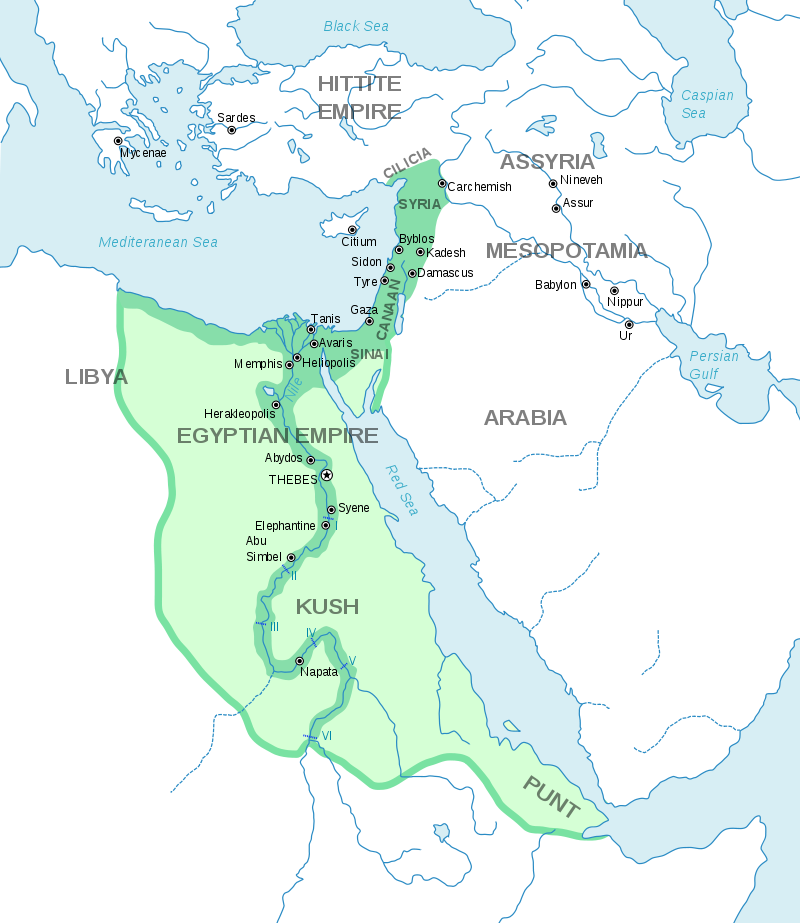
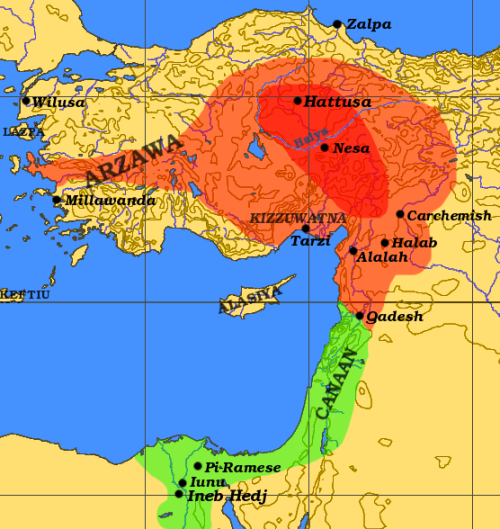
Green: The Egyptian Empire.  Red: The Hittite Old Kingdom. Orange: The extent of Hittite control.

Both Egyptian and Hittite interest in obtaining the coastal region of the Mediterranean saw many uneasy maneuverings (in the form of short-lived strategic treaties) as skirmishes between the two were not uncommon. To their east flank, whenever a Mitannian military unit appeared on the horizon, a marriage proposal would be offered by both greater powers, an offer that would curry favor and ensure an elevated status in such a way that flattered the king of Mitanni into neutrality in all matters, an effective deterrent in their sending any assistance of Egypt or Hatti over the other.

Thus intermarriages especially became commonplace toward the beginning of 15th century BC and was not merely exclusive between these three kingdoms. Letters during this century included an elaborate recounting of a Babylonian princess marrying into the Egyptian royal harem1.

The use of gold as a bargaining tool for bribery was another tactic of advanced statesmanship between sides in their respective courts. If a king rejected a gift of gold douceurs per se, reasoning that the presentation was too meagre an offer and taken as a slight. . . Well, that could very well be the means for the Hittites to attack the Egyptians and vice versa. By the same token, it could also buy temporary friendship between sides, which was rather more the customary outcome whenever gold was utilized in this fashion.

Well into Thutmose III's reign (1501-1447), on his twenty second year, he led his Egyptian army into a large scale invasion of Palestine, leaving the prince of Kadesh (Qadesh) and his allies to scramble together an ill-prepared and futile defense. News travelled quickly and was brought before the king of Assyria, and when Thutmose's legion eventually crossed the Euphrates, they were greeted with open arms and gifts, in the form of gold, silver, and lapis2.

After this exchange, the Egyptian king viewed Assyria favorably as evidenced by a certain cuneiform letter by an Assyrian man, Adadnirari, of which its text bears mention how Thutmose III had appointed his grandfather, Taku, as a chief to preside over an area known as Nukhashshi. The Egyptian king entrusted a foreigner with a position of power, the birth of a new concept:  Delegation.

At this point, Egypt's expansion claimed Halab (Aleppo) and Carchemish, and friendly relations from the empire were opened, using the successful interactions with Assyria as a reference point, and soon other nations began to accept to the absolute authority of Thutmose III. The Yezedis (Kurdish) were allowed to occupy the foothills between the two great rivers (Euphrates and Tigris) unmolested. Even the Hittites began to offer gifts suing for peace, for the reputation of Egypt's rule during 15th century BC was unquestionable and unmatched.


  1. Many pharaohs possessed a number of wives and courtesans, and the royal harem was not a place of disgrace in the public eye of the Egyptian people, much to the contrary, such an inclusion meant to be recognized as an official family member of the 18th Dynasty's ruler. To be among those within the royal harem implied a certain prestige and a mutual voice of power reserved only for those who dwelt within this modest collective.
  2. In Ancient History - Part 1 the Mitanni had absconded with the prized gold and silver gate of Ashur, Assyria's capital city. It can be easily understood how the Assyrians were spared from Thutmose III's wroth, yet the Mitanni were not. One hand would appear to wash the other and perhaps revenge was best served cold vis-à-vis with the blade and chariot of Assyria's new ally, the Egyptian conquerors.