Saturday, September 23, 2023

Ancient History - Part 6: Aggressive Negotiations


Following the brief but successful era of Amenhotep III's polity, a changing of the guard swept the Near East. Egypt was now ruled by Amenhotep IV. Burna-Buriash II (1395-1371) now seated Babylon's throne as its Kassite king. But it was in 1386 B.C., that the Assyrian king, Ashur-nadin-akhi, departed from this world and was succeeded by Ashur-uballit (1386-1369), triggering a new event. Following his ascension to the throne, Assyria's new ruler quickly marshalled his forces to subdue two newly risen kingdoms on the northern borderlands: Shubari and Musri.

Even the price of a successful military campaign can reach unfathomable heights. The remnants of cuneiform tablets have preserved the letters between Assyria and Egypt, letters in which Ashur-uabllit requested twenty talents of gold from Egypt's pharaoh. This was the precise amount his predecessor had been gifted by Egypt for the reconstruction of their palace and temples a mere decade earlier.

Meanwhile, the king of Babylon, Burna-Buriash II, played his own game, going to great lengths to sweeten relations between the lands of Egypt and his own. He'd already orchestrated his son's marriage to Amenhotep IV's daughter, both staying together in Egypt, to enjoy the lavish lifestyle bestowed upon those within the pharaoh's immediate household. Since his son's union, the king of Babylon continued to make grand gestures, any effort to keep the bind of that friendship taut.

Burna-Buriash II's latest endeavor saw him travel from Babylon to the Nile, in order to present his daughter-in-law a gift. A beautiful necklet of 1048 beads. His reason (or excuse) for personally transporting it was that with so many beads, he trusted no other man with the responsibility of keeping it fully intact for the entirety of the journey. Once he'd arrived to treat with the Egyptian royals, he witnessed the Assyrian messenger's appearance in court to announce his kingdom's request for gold.

The Kassite king of Babylon was significantly displeased. Should the pharaoh of Egypt grant such an extravagant boon, Assyria might then be viewed as the most favored nation in the eyes of the Near East. Many historians have interpreted Burna-Bruiash II's extreme caution as a "jealous fear". In a bitter refusal to simply allow Assyria to gain itself a pre-eminence with Egypt, Babylon protested Assyria's appeal for gold to fund its conquests.

Later, in other letters of cuneiform tablets, the Kassite king wrote to Amenhotep IV, that should Assyria be granted twenty gold talents, then Babylon should be granted twenty gold talents, for at the time his people were building a new temple in their city of Nippur.

We do not know whether Egypt granted either Assyria or Babylon its requests for gold, though there is little evidence to suggest otherwise. Both kingdoms were favored subjects and Egypt was still known to be quite wealthy during this period. The important thing of note is not Egypt's compliances to these demands but to recognize the growing unease and distrust as the lesser kingdoms squabbled to remain the favorite loyalist of Egypt. 

The example given demonstrates how an honest request from one large group of people within a border, for gold, might offend another, that has little to nothing to do with such a transaction to begin with.

One might surmise that the attitudes of Egypt's subjects had reduced them to a resemblance of dogs, each vying to outdo the other, in competition for its master's attention.

Sunday, September 10, 2023

Ancient History - Part 5: A Polity Is Formed


With relative peace with its new allies, the New Kingdom of Egypt's military forces could now focus on two enemies, the threat of the Hittites on the outside and the Semitic people's rebellious spirit from within. No longer were the roads of Palestine war-torn and unsafe, on the contrary, it had become the crossroads of kings, as their queens, princes, princesses, and advisors, with their hundreds of maidens traveled upon it to carry out their stately business. The air was now filled with diplomatic harmony, for Egypt had successfully created a polity of several states for the first time in recorded history.

Egyptian king, Amenhotep III, did much to please his allies:

  • In the case of the Babylon, Kadashman-Enlil I's sister and daughter, traveled to Egypt and joined the royal harem. The warm treatment toward both well-beloved women dispelled any remaining concerns the Kassite ruler may have held from the past, any looming threats of invasion, all provably unfounded. With their acceptance into the royal harem, Babylon was gifted with influence, not dissimilar in the manner that Thutmose IV performed in marrying the daughter of the Mitanni king, Artatama I, only a decade prior. Babylon now entrusted the safety of its kingdom within the hands of Egypt.
  • In the tenth year of his rule (1401) Amenhotep III renewed his alliance with the Mitanni by marrying their princess, Gilukhipa, daughter of Shuttarna, her family crossing the roads of Palestine into Egypt, to present a dowry worthy of legend.
  • Demonstrating this custom of intermarriage to secure peace, Amenhotep III gave away his own daughter to an emerging small-state in the north-west: Arzawa (modern day Turkey; spec. Western Anatolia).
  • Assyria did not bask in royal marriage during this time, but was far from forgotten. Knowing that its king, Ashur-nadin-akhi (1396), was building a palace in Ashur, Amenhotep III sent twenty talents of gold to decorate its walls. Assyria in turn, occupied itself in productive endeavors, its people benefiting from constructing new wells, dwellings, and a great new temple.
These were relatively peaceful times. However, history would begin to speak a universal truth, a truth not restricted to this era: One generation's success does not guarantee the next to be worthy enough to resume the duties of carrying on the work of their forebears' legacy.

Nothing lasts forever. With new players come renewed appetites flamed by greed, jealousy, and an unsatisfied lust for power. And little did any know ... war was once again on the horizon of the Near East.

Sunday, September 3, 2023

Ancient History - Part 4: Uneasy Peace


Despite peaceful relations with Assyria and Babylon, Egypt mounted a continuous Palestinian campaign. Under the rule of Amenhotep II (1447-1420), the empire of the Nile quelled any civil unrest, amongst the rebellious Semitic people, before moving its armies back into the lands of Syria. While this march was no more than a nominal success, the Mitanni (the westward neighboring state to Assyria) suffered great losses which resulted in a significant displacement of their power and people. So much harm did the Mitanni sustain, that it left them in no other position than to plead for the mercy of Ra's chosen people.

Amenhotep II's successor, Thutmose IV (1420-1411), believed that if the Mitanni could be cooed into friendly terms, much like Babylon and Assyria, there was untapped potential in securing a third subordinate ally. Therein lay the predicament: The king of the Mitanni, Artatama I, was already fiercely befriended and trusted by the Hittites, the chief rival of Egypt. Even though by mid-15th century B.C., war between the Egyptians and the Hittites had been generally reduced to mild skirmishes (upon Syrian soil), tensions continued to boil, and each passing day both sides expected grand-scale battle to resume.

The Egyptian king thusly proposed a royal marriage between kingdoms. Thutmose IV would marry Artatama's daughter, a symbol of protection, one that accompanied the trust that Egypt would harbor no further attack upon the Mitanni any longer, but such a promise would warrant a step even further. Egypt allowed the Mitanni to enter the fold of its vision. With a single marriage, a shockwave rumbled throughout the Near East. The Mitanni's allegiance officially shifted from the Hittites to the Egyptians.

This new development did not rest easily with the two nations of Assyria (ruled by Ashur-bel-nisheshu) and Babylon (ruled by Kara-indash). Unlike his predecessors, for Thutmose IV, the Mitanni were now quickly becoming the Egyptian king's his favored state, or so it appeared.

The two rulers east of the Euphrates agreed upon one thing: Despite any ill-bearing or mistrust they'd once harbored for the other, it must all be set aside, in order to form a united defensive front, should any attack, no matter whom the would-be conquerors be, be led. 

Assyria began refortifying its towns and their city of Ashur, strictly insuring that no weak points existed amongst the battlements. Meanwhile, the Kassites of Babylon were in a state of constant patrol along the borders. 

However, these expectations of a pending defensive war were all for not. Thutmose IV passed away (1411) and his successor, Amenhotep III (1411-1375), immediately sent envoys to treat with Babylon and Assyria. This new king made his intentions well-known; he possessed no desire to expand into the northern mountains of Assyria nor the vast lands eastward into Babylon. He'd admired their nations as loyal subjects and wished to maintain a focus wholly upon the true sources of Egypt's discontent, the unending Palestinian and Syrian wars, respectively.

Amenhotep III's assurances did not go unchallenged by both Ashur-bel-nisheshu and Kara-indash, and when pressed for further explanation, he convinced them that the Egyptian people were a culture well-conditioned to the dry lands of the desert heat. They were not groomed for a cold wintry life in the mountains, pacifying the argument justifying Assyria's fear of the Egyptians as would-be conquerors of their land. When it came to Babylon, Amenhotep stated that the Euphrates River was an unmistakable natural boundary, and officially declared that Egypt would never expand beyond it.

At the conclusions of these entreaties, all sides departed. Satisfied.

Thursday, August 10, 2023

Ancient History - Part 3: The Babylonian Question


Once friendly relations were firmly established with Thutmose III's powerful Egypt, Assyria turned southward to Babylonia. Other than the Mitanni, who once rattled their borders with oppressive raids prior to Egypt's intervention, Babylonia, as ruled by the Kassites, was the nearest neighboring civilization. Following Egypt's grand conquest of the Near East's coast and strategic areas within the Mesopotamia, now was the perfect opportunity for the Assyrian king, Puzur-Ashur IV (1486-1460 B.C.), to address the Babylonian Question.

Would it be peace or war?

The Egyptians had seen fit to allow resident countries to preside over agreed upon boundaries as long as they continued to pay tribute (taxes) in the form of goods and precious rocks and metals used for what passed as currency at that time. How these different peoples interacted with one another was an entirely separate matter.

Not much is known of Puzur-Ashur's reign of Assyria, other than a few short pieces of note:

  • He restored the temple of Ishtar, which one might surmise was thoroughly desecrated at the hands and ill-treatment by their immediate neighbors, the Mitanni, though this is unconfirmed. At present, historians have it on record that the temple did fall into a state of decay and he'd restored it back to its once pristine condition, no less fit for Assyria's chief place of reverence.
  • While no major battles or wars are accounted for during his lifetime, the Assyrian king did commit strenuous efforts and time dedicated to the building of a new defensive structure, a protective wall for Ashur, their capital city, that would shield the newer southern districts that their growing population had rapidly expanded into, a much needed response to any outside danger.
  • But perhaps his grandest recorded accomplishment was the negotiations with the Kassite ruler of Babylon, Burna-Buriash I (1461-1436), where the two met and agreed upon establishing the precise borders between their respective kingdoms. Assyria already carried the experience in such negotiations with the Egyptian empire, that in this case, found themselves as leading the way as opposed to following, and as it was between Thutmose III and Puzur-Ashur IV, it was with Puzar-Ashur IV and Burna-Buriash I.

For the many years that followed, there was a prolonged period of peacetime amongst kingdoms and empires. At one point Burna-Buriash I's successor, Kurigalzu II (1435-1411), was invited by the Canaanites to wage war against Egypt, with a promise of a piece of the Semitic lands that they were so desperately yearning to liberate. To this, Kurigalzu declined, and each of his successors were continually solicited to turn against the great empire of the Near East. Just as their forbearer once demonstrated, each Babylonian ruler also declined, referring to the Egyptian pharaoh as "my brother."

The Egyptians had established dominance for this century (15th century B.C.) by making friends where enemies might once had surfaced. However, as history will often remind, nothing lasts forever, especially in the case of the status quo.

Sunday, August 6, 2023

Ancient History - Part 2: Tributes & Tribulations


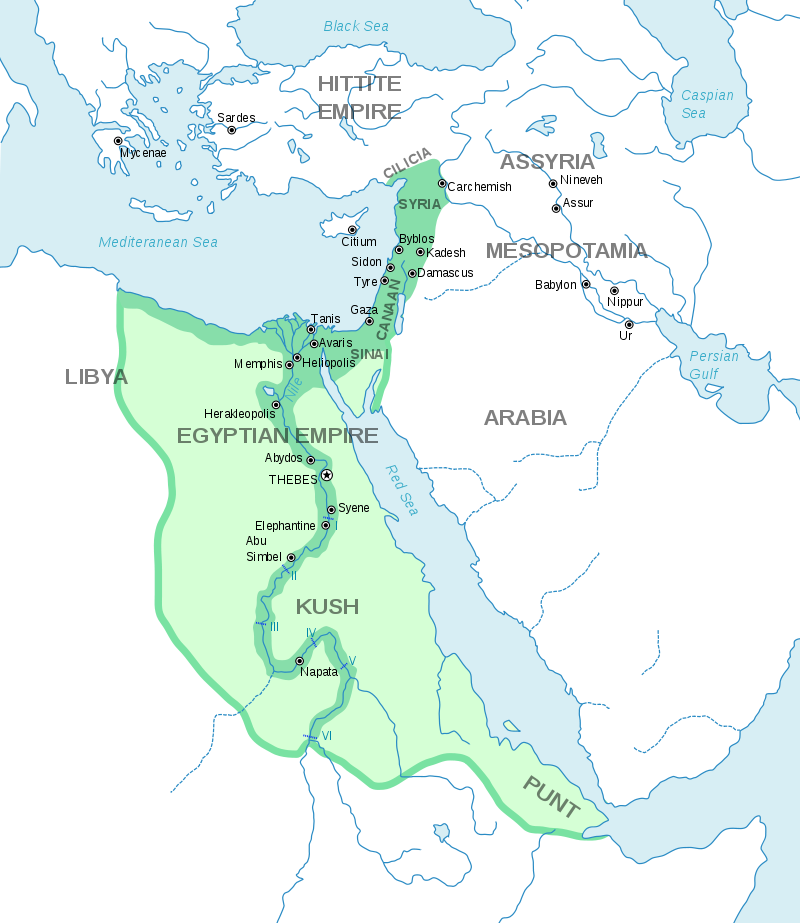
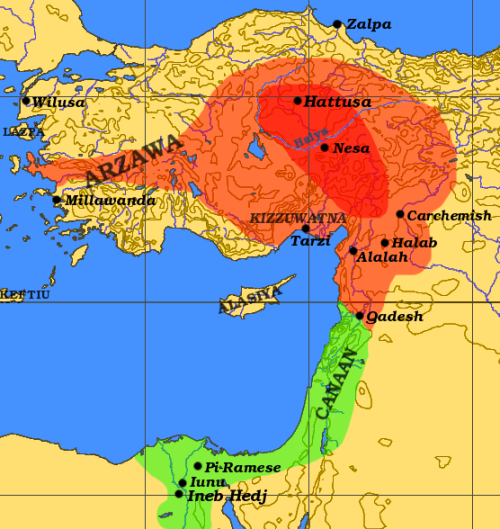
Green: The Egyptian Empire.  Red: The Hittite Old Kingdom. Orange: The extent of Hittite control.

Both Egyptian and Hittite interest in obtaining the coastal region of the Mediterranean saw many uneasy maneuverings (in the form of short-lived strategic treaties) as skirmishes between the two were not uncommon. To their east flank, whenever a Mitannian military unit appeared on the horizon, a marriage proposal would be offered by both greater powers, an offer that would curry favor and ensure an elevated status in such a way that flattered the king of Mitanni into neutrality in all matters, an effective deterrent in their sending any assistance of Egypt or Hatti over the other.

Thus intermarriages especially became commonplace toward the beginning of 15th century BC and was not merely exclusive between these three kingdoms. Letters during this century included an elaborate recounting of a Babylonian princess marrying into the Egyptian royal harem1.

The use of gold as a bargaining tool for bribery was another tactic of advanced statesmanship between sides in their respective courts. If a king rejected a gift of gold douceurs per se, reasoning that the presentation was too meagre an offer and taken as a slight. . . Well, that could very well be the means for the Hittites to attack the Egyptians and vice versa. By the same token, it could also buy temporary friendship between sides, which was rather more the customary outcome whenever gold was utilized in this fashion.

Well into Thutmose III's reign (1501-1447), on his twenty second year, he led his Egyptian army into a large scale invasion of Palestine, leaving the prince of Kadesh (Qadesh) and his allies to scramble together an ill-prepared and futile defense. News travelled quickly and was brought before the king of Assyria, and when Thutmose's legion eventually crossed the Euphrates, they were greeted with open arms and gifts, in the form of gold, silver, and lapis2.

After this exchange, the Egyptian king viewed Assyria favorably as evidenced by a certain cuneiform letter by an Assyrian man, Adadnirari, of which its text bears mention how Thutmose III had appointed his grandfather, Taku, as a chief to preside over an area known as Nukhashshi. The Egyptian king entrusted a foreigner with a position of power, the birth of a new concept:  Delegation.

At this point, Egypt's expansion claimed Halab (Aleppo) and Carchemish, and friendly relations from the empire were opened, using the successful interactions with Assyria as a reference point, and soon other nations began to accept to the absolute authority of Thutmose III. The Yezedis (Kurdish) were allowed to occupy the foothills between the two great rivers (Euphrates and Tigris) unmolested. Even the Hittites began to offer gifts suing for peace, for the reputation of Egypt's rule during 15th century BC was unquestionable and unmatched.


  1. Many pharaohs possessed a number of wives and courtesans, and the royal harem was not a place of disgrace in the public eye of the Egyptian people, much to the contrary, such an inclusion meant to be recognized as an official family member of the 18th Dynasty's ruler. To be among those within the royal harem implied a certain prestige and a mutual voice of power reserved only for those who dwelt within this modest collective.
  2. In Ancient History - Part 1 the Mitanni had absconded with the prized gold and silver gate of Ashur, Assyria's capital city. It can be easily understood how the Assyrians were spared from Thutmose III's wroth, yet the Mitanni were not. One hand would appear to wash the other and perhaps revenge was best served cold vis-à-vis with the blade and chariot of Assyria's new ally, the Egyptian conquerors.

Tuesday, August 1, 2023

Ancient History - Part 1: The Birth of an Empire


Let us travel back to 16th century BC . . .  Where the great lands of the civilized world were Egypt, Hatti (geographically: modern day Turkey; ruled by the Hattians, later the Hittites), Assyria, Babylonia (conquered and controlled by the Kassites by this time, remained known as Babylonia), and Elam (geographically: modern Iran). Of these five grand powers of the known ancient world, Egypt and Hatti rivaled near the top of the hierarchy, with Egypt in first as the power center of the Near East (what we now refer to as the Middle East). A very distant third, in terms of both military power and expansive trade, would have been Babylonia, but it was without doubt inferior in all aspects to the grander two empires above its station.

Assyria was in its infancy, and would later grow to a vast empire of its own right, but during this era was but a small state, well-protected but also isolated by the endless miles of unexplored rough terrain that surrounded its nation.

Egypt was coming off the heels of expelling the Hyksos (Asian invaders of unknown tribe or origin) and following this invaded the Semitic lands of Palestine and all the fertile grounds around them. Thutmose I pressed the might of his Egyptian military forces into Syrian lands and all the way to the Euphrates River.

Three hundred years prior, the Hittite ruler, King Murshil I, swept down from the hills of Taurus and took much of the lands of Syria, a culmination that bore witness to their taking over Aleppo. His freebooters sailed down the Euphrates to raid Babylonia, and historians debate whether or not such attacks were referenced in The Books of Chronicles in the Bible.

These attacks were the height of incursion on the part of the Hittites to Babylonian lands, for concern that too much force might expose their rear flanks to the forever-pending threat of an Egyptian invasion. Such were the political conditions and theater of war at this time.

Sharing in the western portion of their lands, the Assyrians were overshadowed in history by the strength of the Mitanni. So strong was this nation that their king, Shaushshatar, invaded Assyria's capital city, Ashur, and carried off its gate, fashioned from gold and silver and a structure of pride for the Assyrian people. Stolen, they thereafter erected it in the Mitanni capital, Washshukkani, as a trophy of Assyria's submission. This act of humiliation likely drew Assyria's ire for many forthcoming generations.

Throughout 16th century BC to 14th century BC, the Near East was engulfed by ongoing Syrian and Palestinian wars. However, the two nations of Assyria and Babylonia were prevented from taking part, largely due to two buffer zones. First, the brutish Mitanni lay directly north and west of the Assyrian people. Second, the desert east of Palestine separated Babylonia from its most direct route to the convergence of military campaigning.

Adding to this isolation, historians must also consider the geography. While the lands of Assyria and Babylonia lay to the east of the Euphrates, all of the action between Egyptian, Semitic, Hittite, and Mittanian forces fought for blood west of the great river. 

It is most interesting to note that while the Egyptian and Hittite empires exhausted time, resources, and lives in a state of perpetual mass warfare, youthful Assyria remained untouched, and thus became the genesis of its growth into a great empire, facing little resistance in slow expansion into uncontested northern lands, with an eye on the lands of Babylon to the south.